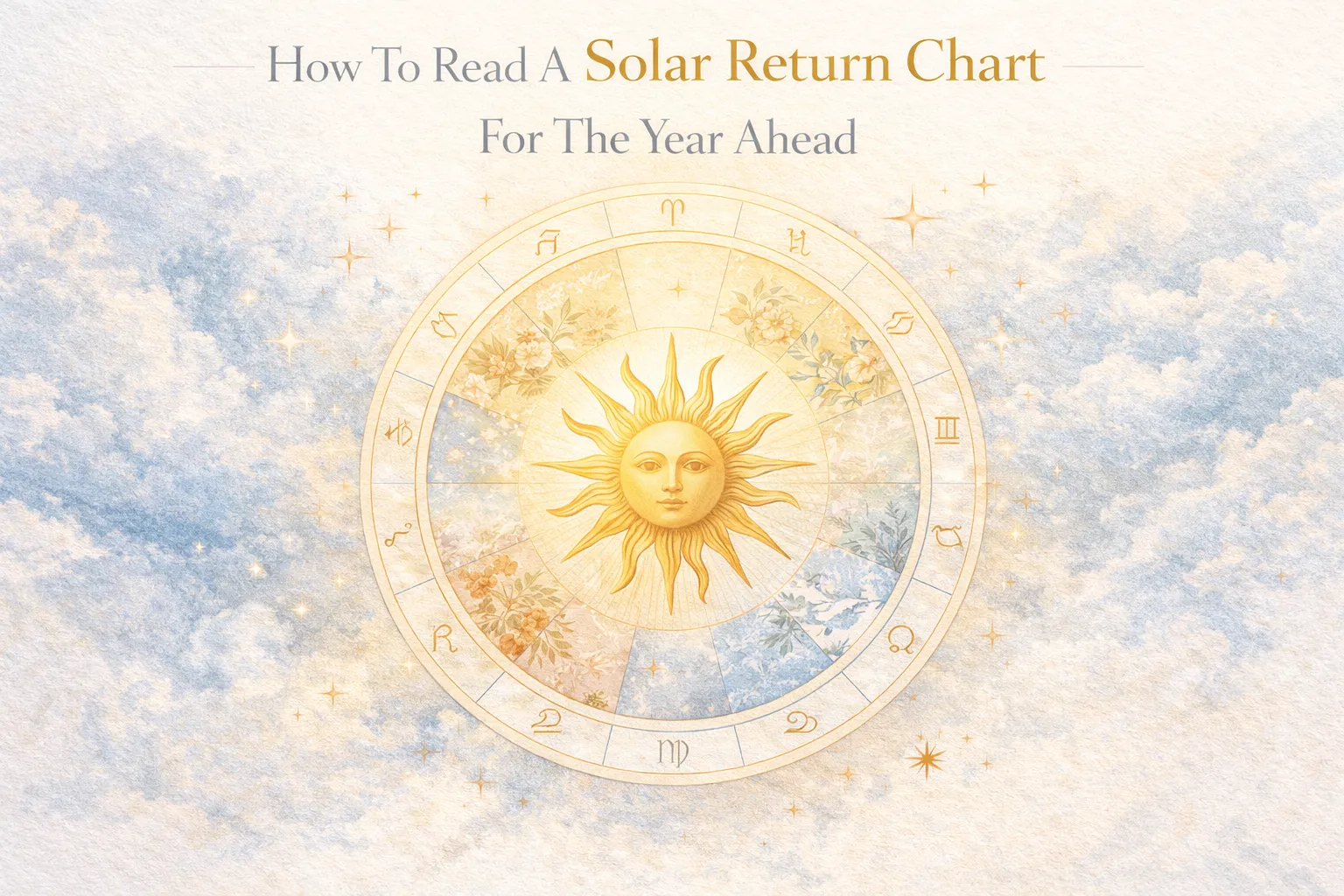
How To Read A Solar Return Chart Without Getting Lost
A clear, beginner-friendly way to read a solar return chart by focusing on the few parts that actually set the tone of the year: the Ascendant, the Sun, the Moon, the chart ruler, houses, and repeated themes.
A solar return chart is the yearly layer, not the whole story
A solar return chart is calculated for the exact moment the Sun returns to the same zodiac degree it held when you were born. Astrologers use that chart to understand the tone of the year between one birthday and the next. It can show which parts of life feel more active, what kind of pace the year has, and which themes keep asking for attention.
The first thing to remember is that the solar return does not replace your birth chart. Your natal chart is still the foundation. The solar return is more like a yearly weather map placed on top of it. It helps you ask better questions about the year ahead without treating every symbol as a fixed prediction.
Start with the Ascendant before reading every planet
The easiest way to get lost in a solar return chart is to begin with every planet at once. A cleaner starting point is the solar return Ascendant. The Ascendant describes the style of the year: how you meet life, what kind of posture you may take, and what the year seems to ask from your body, confidence, choices, and attention.
Then look at the planet that rules the Ascendant. This is the chart ruler of the solar return, and it often acts like the engine of the year. Its house shows where a lot of the action develops. Its sign shows the tone. Its aspects show whether the year moves through ease, pressure, adjustment, or a mix of all three.
- Solar return Ascendant: the style and doorway of the year.
- Chart ruler: how the year tends to move in practice.
- House of the chart ruler: the life area that keeps pulling focus.
Read the Sun as the center of the year
Because the whole chart is built around the Sun returning to its natal position, the solar return Sun deserves special attention. Its house often shows where the year asks for more visibility, effort, creativity, ownership, or conscious choice. A fifth-house Sun may bring more focus to creativity, joy, children, dating, or self-expression. A tenth-house Sun may put career direction, public responsibility, or long-term goals closer to the center.
Try not to read the Sun as a promise that one specific event must happen. It is more useful as a spotlight. Wherever the Sun falls, that part of life tends to need more active participation. It may be where you are asked to show up instead of drifting through the year on autopilot.
Use the Moon to understand what the year feels like
The Moon in a solar return chart often describes the emotional climate of the year. Its house can show where your moods, needs, habits, and sense of safety become more noticeable. A fourth-house Moon may make home, family, privacy, or belonging feel central. An eleventh-house Moon may make friendship, community, audience, or long-range hopes feel more emotionally important.
The Moon is especially helpful because not every important year looks dramatic from the outside. Some years are quietly emotional. Some are practical on paper but deeply personal in the way they are lived. When you read the Moon, you are asking what the year feels like from the inside, not just what it appears to be doing.
Look for the busiest houses
After the Ascendant, chart ruler, Sun, and Moon, look at the houses with the most activity. A busy house does not mean that area will be easy or difficult by itself. It means the year keeps returning there. If several planets gather in the second house, money, values, security, and self-worth may need more attention. If the ninth house is busy, study, travel, publishing, worldview, or legal and academic matters may become more visible.
This step helps you avoid giving too much power to one dramatic placement. A single planet can matter, but a repeated house emphasis usually says more about the shape of the year. The more the chart repeats a topic, the more seriously you can take it.
- Busy houses show where life is less likely to stay quiet.
- Angular houses often feel more visible and immediate.
- Repeated house themes matter more than one isolated symbol.
Pay extra attention to the angular houses
The first, fourth, seventh, and tenth houses are called angular houses. In solar return work, they often carry more volume because they describe areas of life that are harder to keep private or vague. The first house points to identity, body, and self-direction. The fourth points to home, family, roots, and emotional ground. The seventh points to partnership, contracts, clients, and direct mirroring. The tenth points to career, visibility, reputation, and responsibility.
If the solar return Sun, Moon, chart ruler, or several planets land in angular houses, the year may feel more outwardly active. That does not automatically make it a huge life chapter, but it does mean the chart is speaking in a louder part of the room.
Compare the solar return to the birth chart
A solar return becomes much more useful when you compare it with the natal chart. The same solar return placement can feel very different for two people because their birth charts are built differently. A seventh-house return year may be very familiar for someone with a relationship-heavy natal chart, while it may feel like a major shift for someone whose natal chart is more independent or career focused.
Look for repeated natal themes. Does the solar return emphasize a house that is already important in the birth chart? Does the return chart ruler contact a natal personal planet or angle? Does the solar return repeat a natal pattern that has always been part of your life? When the yearly chart speaks the same language as the natal chart, the year usually feels more meaningful.
Do not overread every difficult-looking aspect
Solar return charts can look intense on paper, especially when Saturn, Uranus, Neptune, or Pluto are prominent. But a difficult-looking aspect does not automatically mean a difficult year. It may describe pressure, maturity, focus, disruption, uncertainty, or a need to simplify. Sometimes the most useful years are the ones that make you take something seriously.
The same is true for easy-looking charts. A chart full of trines and supportive symbols can still require effort. The better question is not whether the chart looks good or bad. The better question is what it keeps emphasizing, how strongly it connects to the natal chart, and what kind of response it seems to ask from you.
A simple order for reading your solar return chart
If you want a practical reading order, keep it simple. Start with the solar return Ascendant. Find the chart ruler and read its house. Read the Sun and Moon by house. Notice the busiest houses. Check the angular houses. Then compare the main themes with your birth chart. Only after that should you move into smaller aspects and details.
This order keeps the chart from turning into noise. You are not trying to collect every possible meaning. You are trying to find the few themes that keep repeating. Once those themes are clear, the smaller details become easier to place.
- 1. Solar return Ascendant.
- 2. Chart ruler by house, sign, and aspects.
- 3. Sun and Moon by house.
- 4. Busiest houses and angular houses.
- 5. Repeated themes between the solar return and natal chart.
The best solar return reading ends with priorities
A good solar return reading does not need to predict every month of the year. It should leave you with priorities. What part of life is becoming louder? What kind of emotional tone is the Moon describing? Where does the chart ruler send your attention? Which natal themes are being repeated? What deserves care, patience, or more deliberate action?
When read this way, a solar return chart becomes less overwhelming and more useful. It gives you a way to prepare for the year without forcing the chart to say more than it can. The goal is not certainty. The goal is orientation.
See what your solar return says about the year ahead.
Open your solar return and check which houses, angles, and yearly themes are actually activated in your next cycle.