Solar Return vs Lunar Return: Which One Should You Read?
A clear comparison of solar return and lunar return charts so you know when to use the yearly lens, when to use the monthly one, and how they actually work together in practice.
In this article
In short
- Yearly tone versus monthly weather
- Use solar return for yearly direction and major emphasis.
These two charts operate on different scales
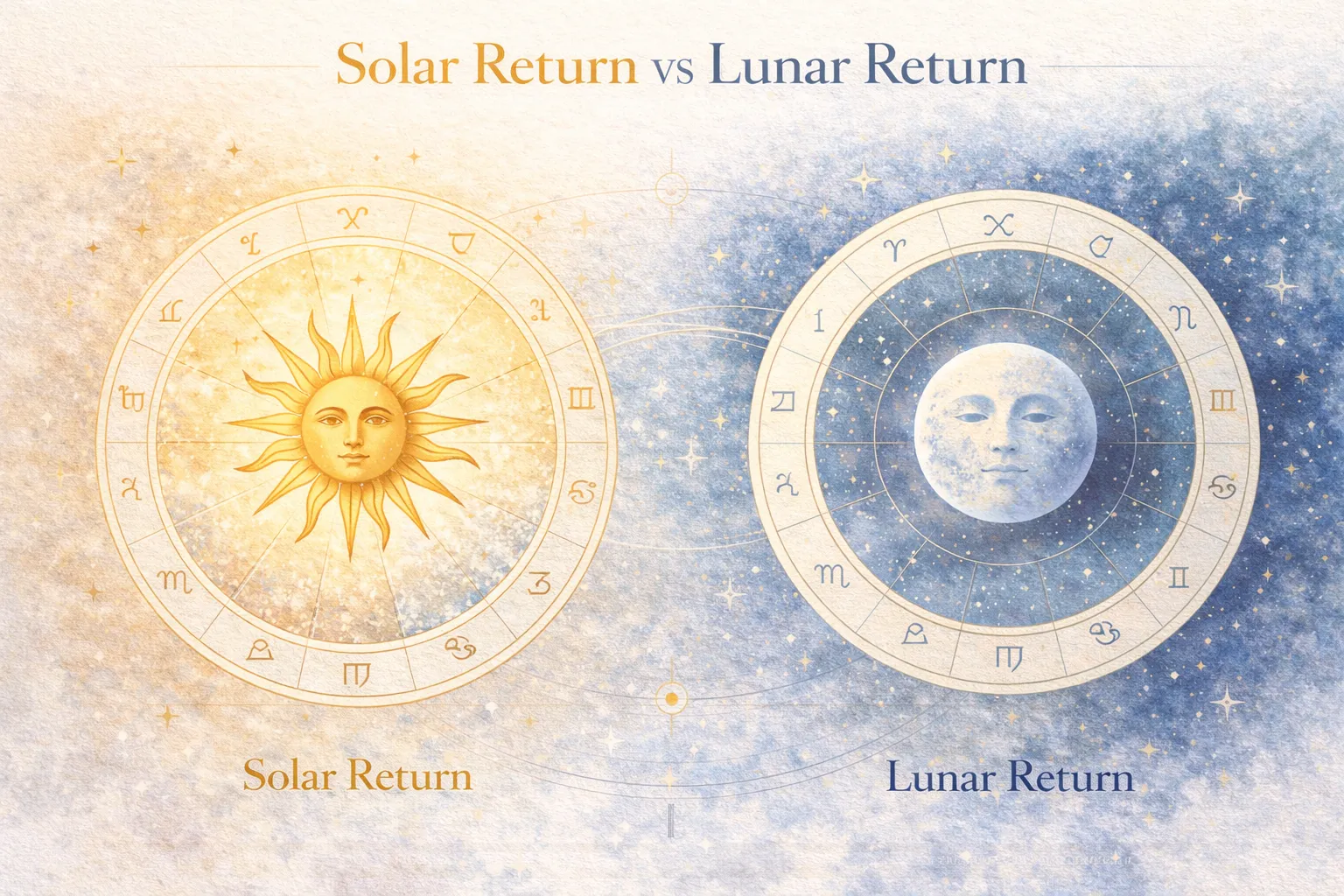
Solar return and lunar return belong to the same timing family, but they are not interchangeable. A solar return describes the tone of a whole year, from one birthday to the next. A lunar return describes a shorter emotional and situational cycle tied to the Moon returning to its natal position, which means it works on a more monthly scale. If you try to make them do the same job, both readings become vague.
The easiest way to separate them is simple: solar return tells you what kind of year you are in, while lunar return tells you what kind of month you are in. One gives the wider structure. The other shows the changing inner weather and shorter-term emphasis moving inside that structure.
Use solar return for the annual headline
If you want to understand the main storyline of the year, start with solar return. It is better for identifying large emphasis: relationships, career shifts, relocation, family restructuring, public visibility, or periods of stronger pressure and responsibility. The solar return Ascendant, angular houses, and major clusters usually tell you where the year will keep asking for attention.
This makes solar return the better first tool for annual planning. It will not tell you every event, but it often shows the dominant arena of growth and the emotional tone that follows you through the year. It answers questions like what this year is about, what subject keeps becoming serious, and what kind of annual atmosphere you are actually living inside.
- Use solar return for yearly direction and major emphasis.
- Read it first when you want a broad annual map.
- It is strongest for big-picture themes, not daily detail.
Use lunar return for shorter emotional timing
Lunar return becomes valuable when the question is closer to the present. It helps you read the mood, focus, and emotional climate of a shorter period. It is often useful when a month feels especially charged, when you want to understand why your inner state has shifted, or when you want a more intimate layer inside an already important year. Because the Moon is involved, lunar return often speaks more directly to felt experience.
This is why lunar return can be so useful during a big solar return year. The solar return may say the year is about partnership, work, or relocation. The lunar return shows how that annual theme is being emotionally processed right now. It can highlight what is nurturing, destabilizing, draining, or emotionally alive in the weeks ahead, even when the larger annual story is already clear.
One chart is structural, the other is responsive
Solar return is usually more structural. It describes the central themes and larger architecture of the year. Lunar return is more responsive. It shows how emotional life is moving inside that structure, where attention is temporarily concentrating, and what the current month feels like from the inside. That does not make lunar return less important. It just means it answers a different class of question.
A useful way to think about it is that solar return tells you what the year is asking for, while lunar return tells you how you are moving through that ask right now. When those two charts repeat the same message, the theme becomes much louder. When they differ, the lunar return often shows a short emotional variation inside the deeper annual arc.
The best method is to read them together, but in order
The cleanest sequence is to open solar return first, then use lunar return as a closer lens. Start with the annual story, then ask how the current month is expressing that story. This prevents overreading the lunar chart and helps you see which emotional fluctuations are part of a larger yearly arc. Without the solar return, a lunar return can look more dramatic than it really is because you do not yet know what larger context it belongs to.
When the two charts repeat the same topic, pay attention. If both point toward relationship shifts, visibility, family focus, or emotional closure, that theme is usually real and timely. If they differ, the solar return still holds the bigger frame while the lunar return shows the shorter pulse moving inside it.
When users usually choose the wrong one
People often choose lunar return when the real question is annual, or choose solar return when the real question is immediate. If the question is why this whole year feels heavy, exposed, or defining, lunar return is too narrow. If the question is why the current month suddenly feels emotionally louder or why a short period is unusually relational or unstable, solar return may be too broad. Timing tools only work well when the time scale of the question matches the tool.
This is one reason comparison matters. The same person may need solar return in one moment and lunar return in another. The better question is not which chart is better in general. It is which chart belongs to the level of timing you are actually trying to understand.
How to use both without getting overwhelmed
If you want a simple workflow, use solar return once to understand the yearly map. Then check lunar return when you want a monthly emotional lens, especially during a period that feels stronger than usual. That keeps your timing practice clean. You are not forcing each chart to say everything, and you are less likely to mistake temporary mood for the whole year or treat the whole year as if it explains every short-term fluctuation.
Read this way, the two charts become complementary instead of competitive. Solar return shows the year's architecture. Lunar return shows the month moving inside that architecture. Together they make timing more specific without making it messy.
See what your solar return says about the year ahead.
Open your solar return and check which houses, angles, and yearly themes are actually activated in your next cycle.
Sources and methodology
This comparison follows Regu's active return-chart contracts. Solar Return finds the instant the transiting Sun returns to its natal zodiac longitude; Lunar Return finds the corresponding return of the Moon. Both cast houses for the selected return location and house system, while the faster Moon creates the shorter cycle.