When A Solar Return Is Loud Enough To Matter
A more advanced way to judge whether a solar return year is merely descriptive or truly significant, so you can tell when the annual chart is repeating natal themes strongly enough to mark a real turning point.
A solar return only becomes truly loud when it repeats something important
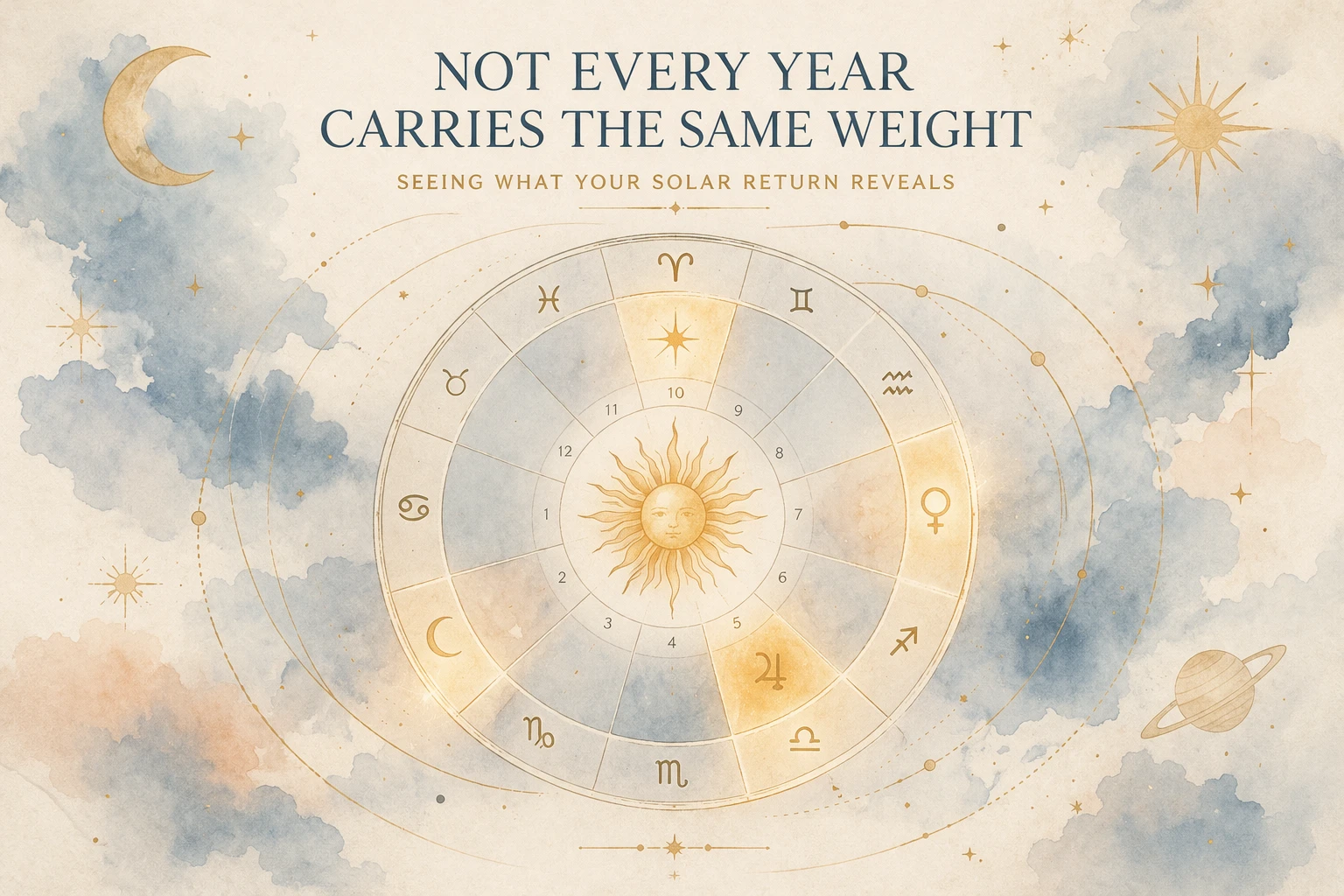
A solar return can always describe the atmosphere of a year, but not every return deserves the same interpretive weight. Some years feel thematically clear without being defining. Other years feel as though the annual chart has reached down into the natal structure and pulled one of the deeper life stories into the foreground. That is the difference between a descriptive return and a loud return.
The cleanest way to judge volume is not to ask whether the solar return looks dramatic in isolation. It is to ask whether the return is repeating natal priorities strongly enough that the year becomes difficult to live as a background chapter. When the annual chart starts echoing natal angles, natal rulers, natal house emphasis, or a long developmental transit, the year usually matters more.
Angular repetition is one of the clearest signs
One of the fastest indicators is angular repetition. If the solar return Ascendant or Midheaven lands on or near a natal angle, or if the return heavily emphasizes houses that are already loud in the natal chart, the year tends to become more visible and more consequential. Angular symbolism is hard to keep private. It pushes life into a form that has to be dealt with directly.
This is why some solar return years feel immediately undeniable. They do not just suggest a topic. They organize attention around it. A return first-house emphasis can make identity, body, autonomy, or direction impossible to treat lightly. A return tenth-house emphasis can pull vocation, public pressure, or responsibility into the center even when the person hoped for a quieter year.
- Return angles close to natal angles usually increase significance.
- Heavy return emphasis in natal angular houses often marks a visible year.
- Repeated first, fourth, seventh, or tenth house activation deserves extra weight.
The chart ruler and the Sun tell you whether the year has real force
A solar return becomes louder when its chart ruler is strongly placed, heavily aspected, or tied to a natal priority. The ruler describes how the year moves. If it is angular, tightly configured, or contacting a natal luminary, the year usually has more force behind it. The Sun matters in a similar way. The solar return is built around the Sun's return to its natal position, so the return Sun's house, aspects, and relationship to natal structure often show what the year is actually trying to foreground.
In weaker years, the ruler may still describe a real tone but without the same level of pressure, repetition, or consequence. In louder years, the ruler and Sun stop looking incidental. They begin to behave like organizing centers. You can see where the year's attention gathers and why the person may feel less free to ignore that subject.
Clusters, exact aspects, and heavy configuration usually raise the volume
Another sign of a loud solar return is concentration. A year with multiple planets clustered in one house or one hemisphere often carries more weight than a chart whose symbols are evenly dispersed. Concentration does not automatically mean hardship. It means the year is less scattered. Life keeps returning to one zone of experience.
The same principle applies to exact aspects. If the return chart contains very tight contacts involving the Sun, Moon, chart ruler, angles, Saturn, Uranus, Neptune, or Pluto, the year often feels more organized around one serious developmental theme. Tightness creates emphasis. A loose chart can still be meaningful, but a tightly configured return tends to feel more insistent.
- Planet clusters often show where the year keeps gathering force.
- Exact aspects make the chart feel more coherent and less incidental.
- A heavily configured ruler or luminary usually means the year has a stronger agenda.
A solar return matters most when it agrees with other timing layers
The loudest years are rarely speaking alone. A solar return becomes much more trustworthy when it agrees with annual profections, major transits, eclipses, or a longer developmental chapter already in motion. If the profected house, the return emphasis, and current transits are all pointing toward one life area, the year usually deserves serious attention.
This is why solar return work improves so much when it stops being isolated. A seventh-house return year is interesting. A seventh-house return year that also lands in a relationship profection year and includes Saturn or Jupiter transits to natal Venus is a much stronger statement. Agreement between timing layers is one of the clearest ways to tell whether the year is merely themed or actually pivotal.
Natal repetition matters more than dramatic symbolism
People often over-read annual drama and under-read repetition. A return packed with big outer-planet symbolism may look intense on paper, but if it barely hooks into the natal chart it may describe atmosphere more than life change. By contrast, a quieter-looking return can become highly important if it keeps repeating natal patterns that already structure the person's life.
That is why the best question is not whether the solar return looks powerful in the abstract. The better question is whether it is speaking the natal chart's native language. When the return repeats a natal ruler, lights up a natal angle, echoes a natal house emphasis, or reactivates a long-standing pattern, the year usually carries more lived consequence than a visually dramatic chart with weaker natal ties.
What a practical judgment sounds like
A practical solar return judgment sounds measured. The year is loud because the return Ascendant falls near the natal Midheaven, the return ruler is angular, and the same house is being activated by profections and transits. Or the year is quieter because the chart has a clear tone but little natal repetition, weak concentration, and no other timing layer confirming it. This kind of reading protects you from treating every annual chart as a life-defining event.
The real goal is proportion. A loud solar return deserves planning, attention, and respect. A softer return still matters, but in a different register. Once you learn to judge volume, annual astrology becomes much more useful. You stop asking whether every solar return is huge and start asking what makes one year truly weight-bearing while another remains more descriptive than decisive.
See what your solar return says about the year ahead.
Open your solar return and check which houses, angles, and yearly themes are actually activated in your next cycle.