Venus Conjunct Lilith In Synastry: Chemistry, Shadow, And Obsession
A nuanced reading of Venus conjunct Lilith in synastry, including why the attraction can feel immediate, why it can become psychologically charged, and when the aspect deepens versus destabilizes the bond.
Why this aspect gets so much attention
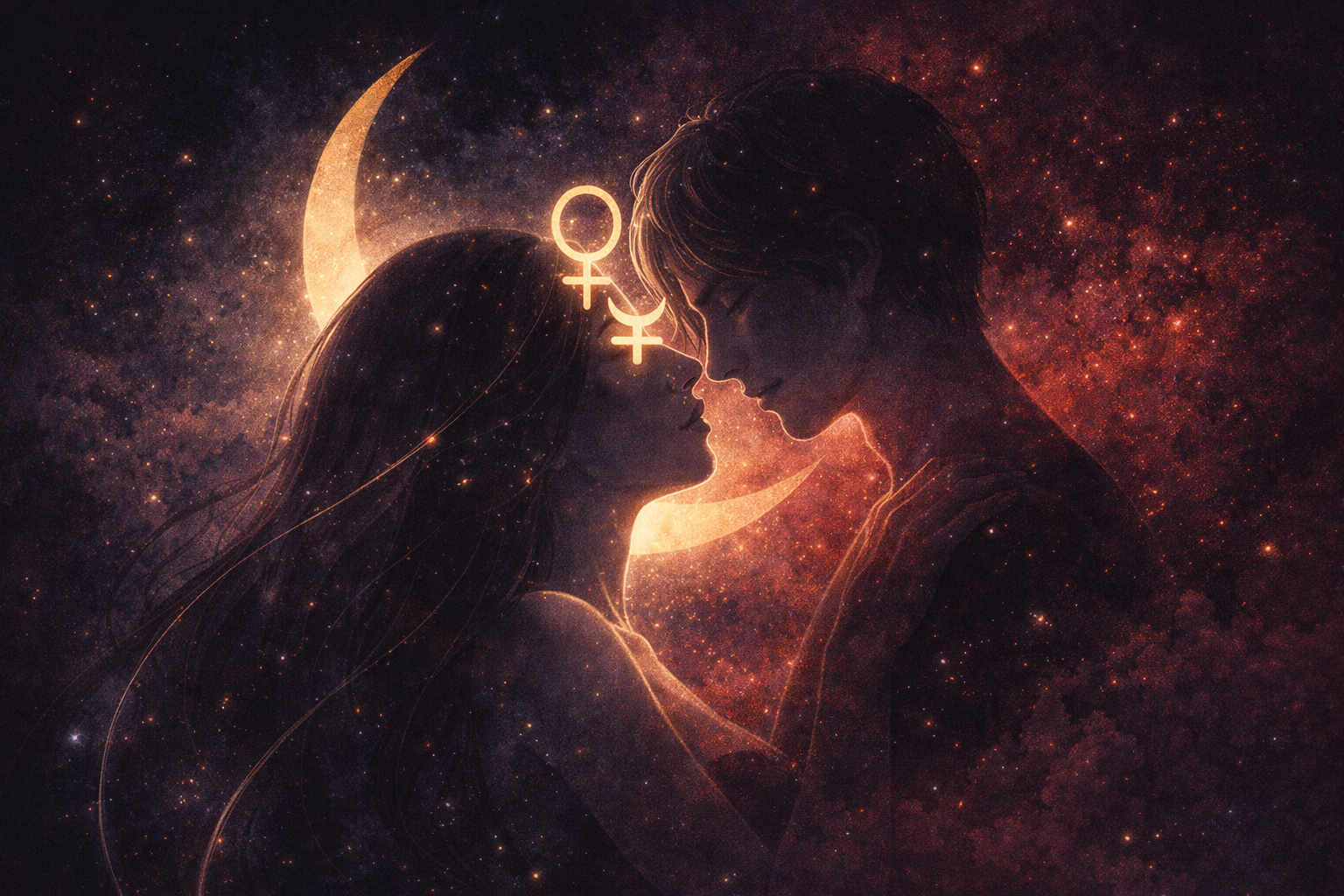
Venus conjunct Lilith in synastry tends to get attention because it rarely feels neutral. There is often instant fascination, heightened sensual awareness, and a feeling that attraction has crossed into something psychologically charged. Venus wants harmony, beauty, and receptivity. Lilith introduces shadow, instinct, rawness, and the parts of desire that do not always feel socially comfortable.
When the two meet, the bond can feel magnetic, exposing, and difficult to reduce to simple compatibility language. People often experience it as something they can feel in the body before they fully understand it in the mind.
The attraction is real, but it is not always calm
This conjunction often creates strong allure. The Venus person may feel drawn to the Lilith person’s authenticity, defiance, or raw erotic charge. The Lilith person may feel deeply seen, desired, or awakened by the Venus person’s style of affection. In the best cases, the aspect gives the relationship a depth of honesty around attraction and longing.
But that same intensity can become unstable if the bond has little emotional grounding. Desire may quickly mix with projection, idealization, jealousy, possessiveness, or fascination with what feels forbidden. The relationship can become compelling precisely because it activates material that neither person usually keeps this close to the surface.
How the Venus person often experiences it
In this conjunction, the Venus person is often the first to feel that attraction has moved beyond simple liking. They may experience the Lilith person as unusually magnetic, hard to categorize, sexually compelling, or emotionally provocative in a way that bypasses their normal filters. Even when Venus usually prefers softness or predictability, Lilith can make desire feel sharper, riskier, and harder to contain.
At times the Venus person feels seduced not only by the other person, but by the version of themselves that comes alive around the Lilith person. This can be liberating when Venus has been too cautious, but it can also create confusion if the Venus person begins idealizing intensity itself. One of the main growth points for Venus here is learning the difference between genuine attraction and compulsive fascination.
How the Lilith person often experiences it
The Lilith person often feels something different: they may experience the Venus person as someone who draws out a softer, more relational, or more visibly desirable part of them, while also touching their defenses around shame, rejection, or being too much. Lilith tends to be raw and hard to domesticate, so contact from Venus can feel deeply flattering, disarming, or exposing.
Because of this, the Lilith person may alternate between receptivity and self-protection. They may feel intensely desired and simultaneously suspicious of being romanticized, tamed, or only partially understood. When the aspect goes well, Lilith feels welcomed without being edited. When it goes poorly, Lilith feels wanted only as fantasy, while the real, inconvenient emotional truth gets pushed aside.
Who usually feels it more strongly
This is one of those conjunctions where both people usually feel it, but not in the same way. Very often the Venus person feels the aesthetic and erotic pull first, because Lilith presses directly into Venusian desire and taste. The Lilith person may feel the contact just as strongly, but more as activation of vulnerability, power, self-consciousness, or instinctive intensity.
So if you are asking who carries more of the immediate attraction, the Venus person often reports the cleaner experience of being magnetized. If you are asking who carries more of the shadow material, the Lilith person often feels more exposed. The exact balance changes if Lilith is heavily emphasized in one chart, if the orb is very tight, or if the conjunction also touches angles, the Moon, or the ruler of the seventh house.
- Venus often feels the pull as attraction, style, and fascination.
- Lilith often feels the pull as exposure, instinct, and shadow activation.
- A tighter orb usually makes the asymmetry more obvious, not less.
Shadow themes matter more here than in softer Venus aspects
Unlike a simple Venus trine, this aspect asks both people to confront what attraction means to them when comfort is not the only goal. Shame, control, seduction, vulnerability, power, and fear of rejection can all become more visible. That is not necessarily a problem, but it does mean the relationship is less likely to stay light if the connection grows.
In practice, the aspect works better when both people can tolerate complexity. If one person wants only sweetness while the other lives close to emotional intensity, the attraction may stay powerful but become harder to stabilize.
What makes the conjunction more workable
Venus conjunct Lilith is easier to live with when the chart also contains emotional maturity and relational containment. Moon contacts can provide softness. Saturn can provide structure if it is not excessively punitive. Good Mercury contact helps because this aspect often needs language around boundaries, desire, jealousy, projection, and what each person is actually asking of the other.
It also becomes more workable when both people are honest about what the attraction is doing. If the bond is being carried mainly by sexual fascination, emotional intensity, or the thrill of transgression, the relationship will need more support elsewhere to remain stable. If the conjunction is part of a larger pattern of warmth, trust, and repair, it can become one of the most intimate and psychologically alive parts of the synastry.
Read the full chart before calling it destiny
Venus conjunct Lilith can absolutely describe unforgettable chemistry, but chemistry alone is not enough to define the relationship. Look for Moon contacts, Saturn contacts, angle contacts, and the broader relational tone of the synastry. Those layers will tell you whether the conjunction becomes a meaningful part of a larger bond or remains a potent but destabilizing current.
The best way to read this aspect is not to ask whether it is good or bad. Ask whether the attraction opens both people into greater honesty and aliveness, or whether it keeps them trapped in a cycle of fixation, projection, and unresolved hunger.
See what aspects you and your partner share.
Open your synastry chart and see how Venus, Moon, Saturn, Lilith, and other key contacts show up in your actual chart pair.