
The composite chart
Build the midpoint relationship chart to see composite placements, central needs, and internal aspects of the shared chart.
Composite Chart
Build the midpoint relationship chart to see composite placements, central needs, and internal aspects of the shared chart.
Choose a city from the suggestions for coordinates.
Choose a city from the suggestions for coordinates.
Chart settingsPlacidus
Affects houses, angles, overlays, and house-based readings.
Uses the standard midpoint composite method
Read composite placements with better relationship context.
Composite charts work best when users already understand what synastry shows, how attraction indicators can distract, and how emotional familiarity differs from the deeper shared chart pattern.
Browse all readings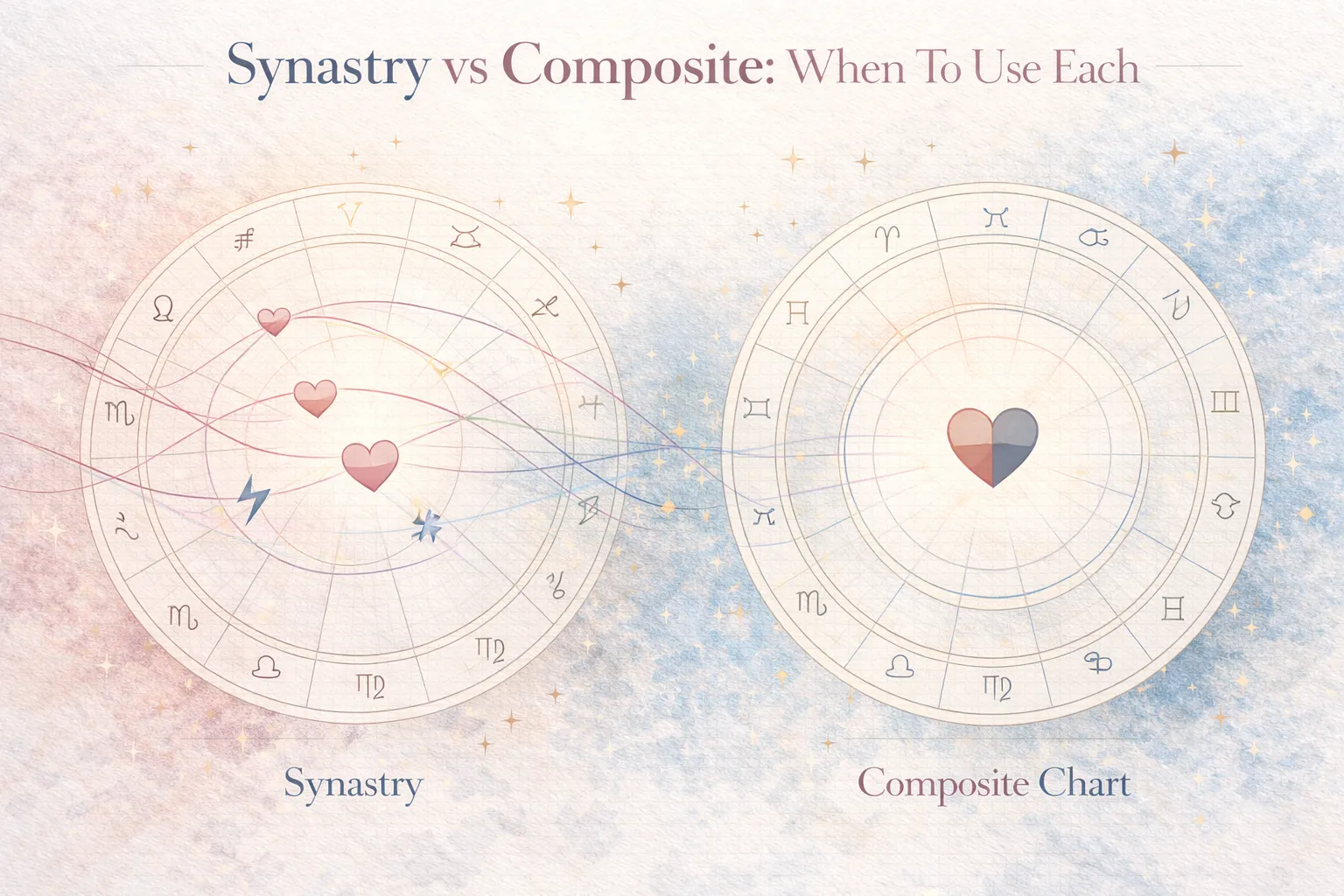
Synastry Vs Composite: When To Use Each
The most direct guide for understanding what a composite chart adds once synastry already looks strong.

Moon-Venus In Synastry
A steadier companion read when you want to compare composite gravity with warmth, ease, and emotional softness.

North Node Conjunct Venus
Helpful when you want to compare obvious attraction with the sense that the relationship is pulling both people forward.

Why Some People Feel Like Home Immediately
A companion read for Moon-Venus contacts, emotional ease indicators, and repeated inter-chart support.
A Composite Chart Reads The Relationship As Its Own Pattern
A composite chart is useful when the question has moved beyond individual inter-chart aspects. Synastry shows how two people affect each other, but the composite chart describes the shared chart pattern. It can show the tone the relationship tends to create, the needs that keep repeating, and the internal structure that both people step into when the relationship becomes a shared space.
Why Midpoints Can Say Something Synastry Does Not
Composite charts are built from the midpoint between two natal charts, so they should not be read like another person in the room. The value is symbolic and structural: where does the composite Sun land, what does the composite Moon need, which houses become loud, and which aspects repeat tension or ease inside the shared chart. This gives a cleaner view of the relationship as a unit.
How To Use Composite Beside Synastry
Use synastry to understand attraction indicators, friction, overlays, and who activates what. Use the composite chart to understand the shared chart structure. If synastry shows strong activation but the composite chart feels heavy or scattered, the comparison may be intense without reading as stable. If both repeat the same theme, the reading becomes much more reliable.
Calculation standards
How this Regu calculation works
The method, input sensitivity and limits below reflect the active calculation contract rather than a generic description of the technique.
- Exact calculation
- Regu uses the midpoint composite method: each corresponding pair of natal points is converted to its zodiac midpoint and assembled into a separate relationship chart. Houses use the selected Placidus or Whole Sign system.
- Required inputs and precision
- Two birth dates and places, both local birth times when available, and a house system. Unknown times can be entered, but time-sensitive points are then estimates.
- Non-personal example
- If one Sun is at 10° Aries and the other at 10° Gemini, their short-arc midpoint is 10° Taurus. The same midpoint rule is applied to corresponding chart points.
- What the result contains
- Composite planets, angles, houses, aspects, house emphasis and a relationship-chart wheel.
- What it does not claim
- A composite chart is a symbolic midpoint construction. It is not a chart for a physical event and cannot prove compatibility, reciprocity, health or permanence.