
Synastry vs Composite: When To Use Each
A practical comparison of synastry and composite charts so you know what each tool calculates, which questions each one answers, and the cleanest order for reading them together.
In this article
In short
- Two charts, two very different questions
- Use synastry to ask how each person affects the other.
- Use composite to examine the shared tone and recurring structure of the bond.
Synastry and composite are not competitors
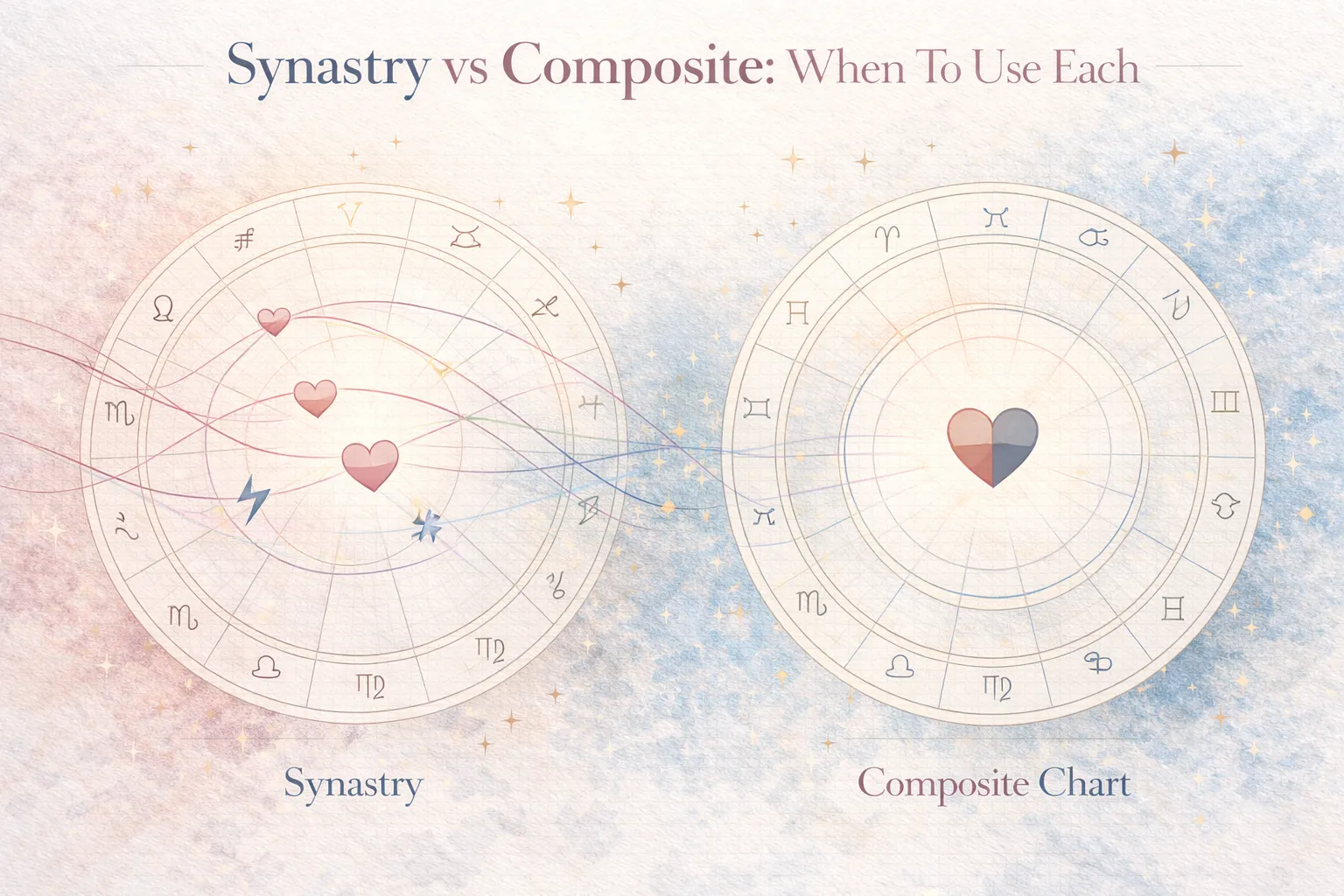
People often treat synastry and composite as if one must be the better relationship tool. They are more useful when they are separated by question. Synastry compares two natal charts directly and shows how one person's placements contact the other person's chart. Composite calculates a third chart from the midpoints between the two natal charts and describes the patterns that become visible when the relationship functions as a unit.
The distinction is practical. Synastry helps explain why one person feels soothed, challenged, attracted, exposed, or misunderstood around the other. Composite helps describe the shared atmosphere the pair tends to create: private or public, light or demanding, stable or changeable, focused or difficult to define. One describes interaction between two people. The other describes the relationship pattern their interaction produces.
What a synastry chart actually compares
Synastry keeps both natal charts intact. The calculation compares the planets and angles in chart A with the planets and angles in chart B, then places each person's planets into the other person's houses. This is why synastry is directional. Your Moon in another person's fourth house describes your Moon entering their fourth-house territory; their Moon in your tenth house describes a different experience. The two overlays should not be treated as interchangeable.
Inter-chart aspects add another layer. A Moon-Mercury contact can describe how emotion and language meet. Venus-Mars can show attraction and movement. Saturn contacts can add commitment, consequence, inhibition, or pressure. No single aspect settles the relationship. The useful information comes from repetition across personal planets, angles, house overlays, and the wider natal context of both people.
- Use synastry to ask how each person affects the other.
- Keep house overlays directional instead of assuming both people feel the same thing.
- Look for repeated themes before giving one dramatic aspect too much weight.
What a composite chart actually calculates
A midpoint composite chart does not blend two personalities into one average person. It calculates a symbolic position halfway between each pair of corresponding natal points: the two Suns, the two Moons, the two Venuses, and so on. Those midpoint positions form a separate chart with its own aspects, houses, angles, and overall emphasis.
Because of that construction, composite works best as a chart of the relationship rather than a description of either individual. A composite Sun can show what the bond organizes itself around. The composite Moon can describe the emotional climate that develops between the two people. Angular planets and concentrated houses can show which parts of life become unusually visible when the pair acts together. These placements still need context; they are not a verdict on whether the relationship is good or bad.
- Use composite to examine the shared tone and recurring structure of the bond.
- Read the composite as a relationship pattern, not as a replacement natal chart.
- Give the Sun, Moon, angles, chart ruler, house emphasis, and tight aspects priority.
Use synastry first when the chemistry is the question
If the main question is about attraction, comfort, communication, emotional friction, or uneven impact, synastry usually comes first. It can show why a connection feels immediate to one person but slower to the other, why affection is easy while conflict is not, or why two people have strong chemistry without naturally regulating each other well.
Synastry is especially useful when a relationship is new, undefined, or difficult to read. At that stage there may not be enough shared history for the composite pattern to be obvious in real life. Looking at the two natal charts first keeps the reading grounded in the people who are actually present instead of projecting a complete relationship story onto an early connection.
- Start here for attraction, tension, compatibility, and interpersonal style.
- Use it when you want to know who activates what in whom.
- Use it before composite in early-stage, undefined, or inconsistent connections.
Use composite when the relationship has become a real system
Composite becomes more useful when the relationship has enough continuity to behave like a system. The pair may have routines, shared responsibilities, a recognizable public identity, a private emotional climate, or recurring problems that belong to the bond rather than to one isolated interaction. At that point the question is no longer only how the two people trigger each other. It is also what repeatedly happens when they build, decide, withdraw, repair, or move through pressure together.
This is why composite can become clearer with lived history. A concentrated fourth house may match the way the relationship turns inward and organizes around home or privacy. A strong tenth-house emphasis may describe a bond that becomes visible through work, reputation, or shared ambition. A prominent Saturn may show the seriousness, endurance, limits, or obligations that shape the relationship. The chart is most useful when these symbols are compared with what the pair is demonstrably creating.
Accurate birth times matter differently in each chart
Both techniques become less precise when a birth time is missing or uncertain. In synastry, many planet-to-planet aspects can still be compared, although the Moon may shift meaningfully during the day. The Ascendant, Midheaven, house cusps, and house overlays cannot be treated as reliable without a dependable birth time. A reading should say clearly when those layers are unavailable instead of quietly using a noon estimate as fact.
Composite angles and houses are also time-sensitive because they are derived from the two timed natal charts. If either time is uncertain, focus on the composite planets and their tighter aspects, and treat the house structure as provisional. Precision is part of interpretation: a confident statement based on an unreliable angle is not a deeper reading, only an overstated one.
The cleanest reading order uses both in sequence
A useful workflow begins before either relationship chart. Read enough of each natal chart to understand how both people handle emotion, affection, conflict, boundaries, and commitment on their own. Then open synastry and identify the strongest repeated contacts. Only after that should composite be used to examine the relationship's shared structure.
This order prevents a common mistake: asking the composite chart to explain a problem that is already obvious in one person's natal pattern or in a directional synastry contact. It also keeps the comparison efficient. You do not need to interpret every asteroid, minor aspect, or house cusp before the central pattern is clear. Start with the layers that carry the most weight, then add detail only when it changes the answer.
- First: understand the relevant natal patterns in both charts.
- Second: use synastry for inter-chart aspects and directional house overlays.
- Third: use composite for the shared emotional climate and relationship structure.
- Last: compare the chart language with the relationship's actual behavior and history.
What it means when synastry and composite seem to disagree
The two charts can appear to tell different stories because they are describing different layers. Strong Venus-Mars or angle contacts in synastry may produce immediate attraction, while a Saturn-heavy composite can show that the relationship itself feels serious, delayed, duty-bound, or difficult to keep light. The attraction is not cancelled by the composite; it is being placed inside a more demanding shared structure.
The reverse can happen too. Synastry may contain several awkward contacts that require patience, while the composite has a coherent Sun, Moon, or Venus pattern that helps the pair build a recognizable life together. That does not erase interpersonal friction. It means the relationship may function more clearly as a unit than the individual interactions feel in every moment. Instead of choosing which chart is correct, identify which question each one is answering.
Neither chart can make the relationship decision for you
Synastry and composite can organize observation, but they cannot prove that a relationship is healthy, mutual, permanent, or destined. A compelling contact can describe intensity without consent, consistency, or emotional safety. A stable-looking composite cannot guarantee that both people want the same future. Real behavior, communication, boundaries, circumstances, and willingness to repair remain more important than a symbolic chart pattern.
Use these tools to ask better questions rather than to avoid them. Synastry can help name where the interaction feels easy or loaded. Composite can help name what the relationship keeps becoming. The reading is strongest when those observations lead back to lived evidence instead of replacing it.
Use the free synastry chart calculator for your own charts.
Compare two birth charts and see how Venus, Moon, Saturn, Lilith, house overlays, and other key contacts show up in your actual chart pair.
Frequently asked questions
Should I read synastry or composite first?
Read synastry first in most cases. It shows how the two natal charts interact and keeps each person's experience visible. Use composite afterward when you want to examine the shared pattern the relationship creates.
Can a composite chart be strong when synastry is difficult?
Yes. The charts describe different layers. A pair can experience interpersonal friction in synastry while still building a coherent shared structure, or have easy attraction in synastry while the composite describes a more demanding relationship pattern.
Does the composite chart show how each person feels?
Not by itself. Composite describes the shared relationship pattern. Directional synastry contacts and each person's natal chart are more useful when the question is how one individual experiences the other.
Do both people need accurate birth times?
Accurate times are needed for dependable angles, houses, and house overlays. Planet-to-planet contacts can still be useful without them, but Moon position, angles, and all house-based conclusions should be treated with caution.
Sources and methodology
Regu treats synastry as a directional comparison between two natal charts, including inter-chart aspects and house overlays. The composite chart is calculated from the midpoints between each pair of corresponding natal positions. The reading guidance below is symbolic and educational; neither technique can verify relationship quality, compatibility, or future outcomes on its own.