Venus Conjunct Mars In Synastry: Attraction, Heat, And Relationship Chemistry
A detailed guide to Venus conjunct Mars in synastry, including why the chemistry can be immediate, how Venus and Mars experience it differently, and what determines whether the attraction becomes sustainable.
Why Venus-Mars is one of the classic attraction aspects
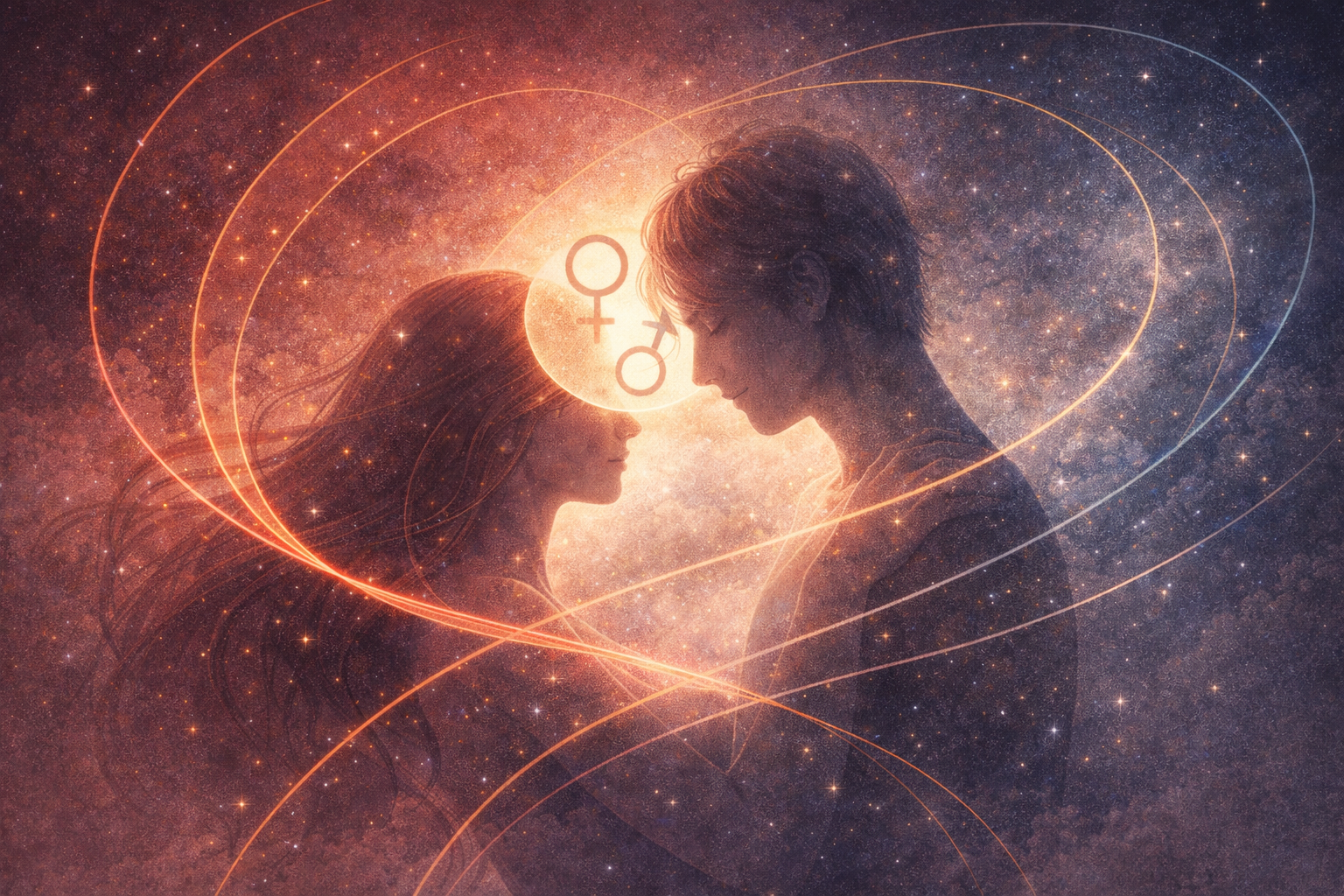
Venus conjunct Mars is one of the most talked-about synastry aspects because it often creates immediate chemistry. Venus represents attraction style, pleasure, relational softness, and what feels desirable. Mars represents instinct, pursuit, sexual drive, and the way desire moves toward action. When they meet, attraction often becomes vivid, embodied, and hard to mistake for indifference.
This is why the aspect is so recognizable in real life. The relationship may feel flirtier, more alive, more physically charged, or simply more difficult to keep in the realm of platonic calm. Even when both people are trying to stay measured, the body often understands the contact before the mind organizes it.
How the Venus person often experiences it
The Venus person often experiences the Mars person as exciting, energizing, and erotically direct. There is usually a strong sense of being pursued, awakened, or stirred into more visible desire. The Mars person can make the Venus person feel more attractive, more embodied, and more aware of what they want physically or romantically.
At times, though, the Venus person can also feel rushed if the Mars tone is too aggressive for their natural pace. The conjunction is strongest when pursuit feels enlivening rather than invasive. If Venus feels continually pushed past its emotional rhythm, the attraction remains real but becomes harder to enjoy.
How the Mars person often experiences it
The Mars person often experiences the Venus person as magnetic, inviting, and impossible not to move toward. Venus can feel like a direct answer to Mars instinct: appealing, responsive, beautiful, and relationally significant in a way that turns desire into a focused pursuit. Mars may feel more alive, more confident, or more urgent around the Venus person.
Because Mars is the activating principle, the Mars person often feels more visibly motivated by the aspect. But that does not always mean Mars feels more deeply. Sometimes Mars carries more of the obvious pursuit while Venus carries more of the emotional pleasure and relational receptivity. The exact balance depends on the rest of the chart.
Who usually feels the chemistry more
This is one of the few conjunctions where both people usually notice the attraction quickly, but the flavor differs. Mars often feels more urgency, more chase, and more physical compulsion. Venus often feels more pleasure, more magnetism, and more of the relational sweetness that makes attraction feel enjoyable rather than merely intense.
So if you ask who feels more of the raw charge, it is often Mars. If you ask who feels more of the pleasure and relational allure, it is often Venus. In the healthiest version, the conjunction creates mutuality: one person is not merely chasing while the other is merely receiving. Instead, the chemistry circulates.
- Mars often carries more visible pursuit and urgency.
- Venus often carries more sensual pleasure and attraction.
- Mutual support elsewhere in the chart makes the chemistry far more sustainable.
Why this aspect often feels so easy to notice in real life
Some synastry aspects reveal themselves slowly, but Venus conjunct Mars tends to announce itself quickly. Body language, flirtation, timing, and mutual awareness often sharpen fast. The conversation may feel charged even when the topic itself is ordinary. There is often a subtle sense that attraction is already moving, even before either person names it directly.
This immediacy is part of what makes the aspect beloved and occasionally overrated. People recognize the chemistry and assume the whole chart must therefore be aligned. Sometimes that is true. Sometimes the aspect is simply doing its job very well: making desire obvious.
What the Venus person usually wants from the aspect
Although the Venus person often enjoys the erotic charge, they are usually looking for more than heat alone. Venus wants pleasure, appreciation, reciprocity, and a style of connection that feels relationally satisfying. That means the Venus person often tracks tone very carefully. Are they being enjoyed or merely chased? Is the attraction warm, playful, and appreciative, or is it becoming too one-note and physical?
This is why the Venus person can look fully responsive on the surface and still quietly withdraw if the emotional or aesthetic tone turns rough. Venus usually stays open when desire feels flattering, mutual, and humanized. Venus tends to cool off when chemistry starts feeling consuming but not actually connective.
What the Mars person usually wants from the aspect
The Mars person often experiences the conjunction as permission to move. There is a sense that desire has a target, momentum, and a reason to act. Mars tends to enjoy feeling effective in this aspect. The Venus person often brings out confidence, erotic clarity, and the urge to pursue more directly than usual.
Still, the Mars person also needs feedback. If the Venus person is receptive, Mars often feels invigorated and bold. If the Venus person is ambivalent, inconsistent, or emotionally unavailable, Mars may swing into frustration, over-pursuit, or defensiveness. This is why the conjunction works best when pursuit is actually welcomed rather than merely provoked.
When Venus-Mars becomes relationship glue, not just hot timing
Venus conjunct Mars becomes especially valuable when the chart also includes emotional trust and practical rhythm. Then the chemistry does not have to carry the entire connection by itself. Instead, it becomes a renewable source of warmth, flirtation, sexual vitality, and romantic movement inside a relationship that already has somewhere to go.
When those supports are missing, the same aspect can create a start that feels exciting but difficult to stabilize. People may keep returning to the chemistry because it is real, even when the relationship around it remains underbuilt. In that sense, Venus-Mars is often a powerful accelerator, but not always a complete foundation.
Chemistry is strongest when the rest of the chart can hold it
Venus conjunct Mars is excellent for attraction, but it does not guarantee emotional ease, timing, or longevity. If the relationship has no Moon support, no real communication, or severe Saturn stress, the chemistry may stay strong while the relationship becomes unstable. This is one of the most common mistakes people make when reading this aspect.
The best version of Venus-Mars happens when emotional readability and structural support exist elsewhere in the chart. Then the aspect becomes not only hot, but emotionally inhabitable. Without those supports, it may remain one of the most exciting parts of the synastry while still failing to carry the whole relationship.
See what aspects you and your partner share.
Open your synastry chart and see how Venus, Moon, Saturn, Lilith, and other key contacts show up in your actual chart pair.