
What Does It Mean If A House Is Empty In Your Birth Chart?
Why empty houses are normal and how to read one through its sign, ruler, aspects, and timing instead of treating it as missing.
In this article
In short
- The quiet rooms of the chart are still part of the story
- House: the life topic.
An empty house is not a missing part of your life
One of the first strange moments in reading a birth chart is noticing that some houses have no planets in them. The chart looks busy in one area, quiet in another, and it is very easy to wonder whether the quiet parts mean something has been left out. No planets in the 7th house can make someone worry about relationships. No planets in the 10th can make career feel confusing before the reading has even started. An empty 4th house can raise questions about home, family, or emotional roots.
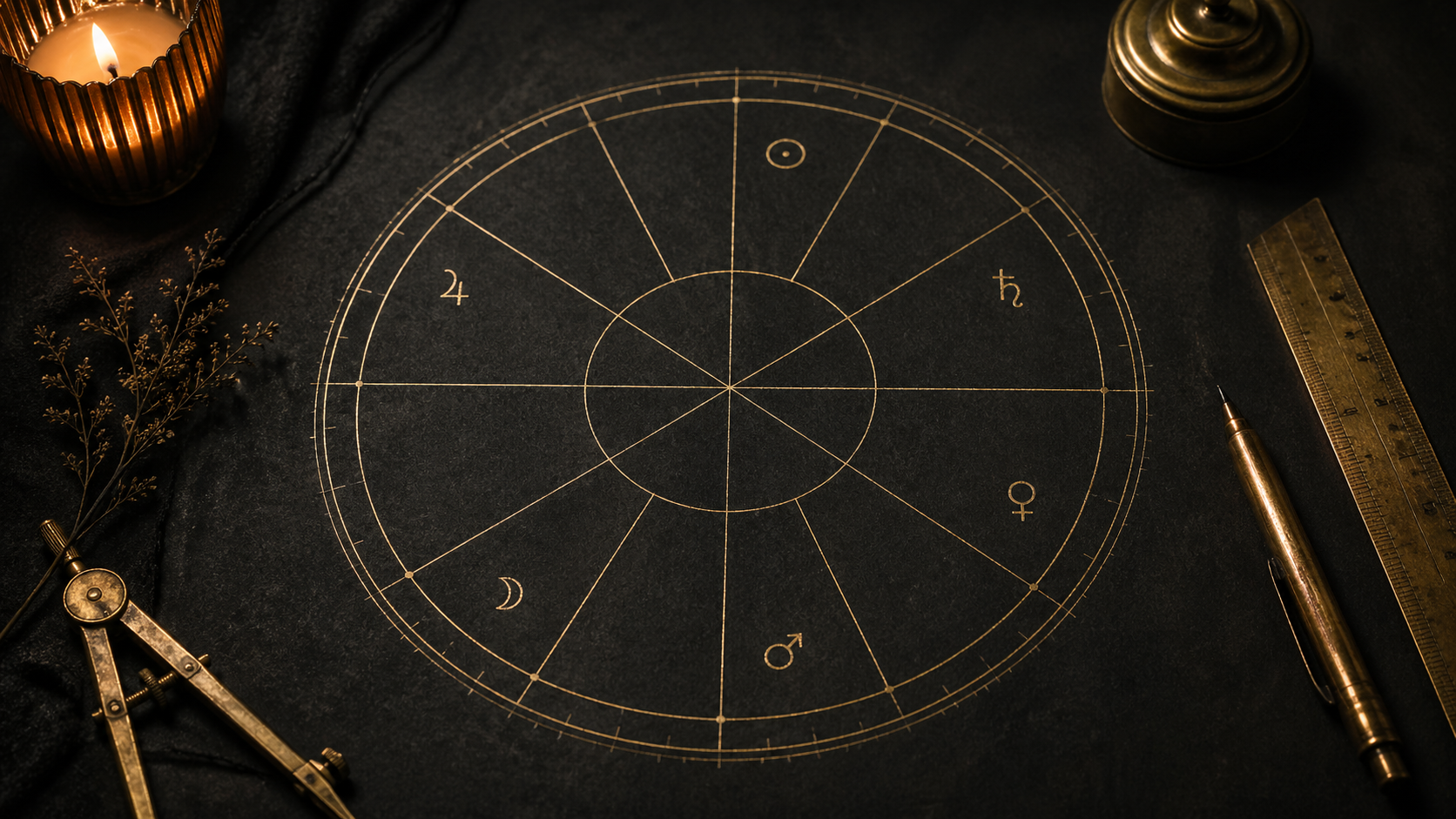
But an empty house does not mean that area of life is absent, blocked, unlucky, or somehow less real. It simply means there were no natal planets placed in that house at the moment of birth. The house still exists. It still has a sign on the cusp. It still has a ruler. It still receives transits. It still becomes active through life. The difference is that its meaning is not being carried by a planet sitting inside the room.
Most charts have empty houses because the math makes them normal
A birth chart has twelve houses, but astrologers usually work with ten major planets when reading the basic structure: Sun, Moon, Mercury, Venus, Mars, Jupiter, Saturn, Uranus, Neptune, and Pluto. Even before anything more complicated happens, that already means not every house can contain a planet. In real charts, planets also tend to cluster. Mercury and Venus are never very far from the Sun, so they often land close together. Some charts gather several planets into one quadrant, one sign, or one life area.
That means empty houses are not rare. They are part of how charts normally distribute emphasis. A chart with several empty houses is not incomplete. It is simply showing that certain areas are not carrying the same concentrated natal pressure as the houses with planets. In practical reading, that is useful information. It tells you where the chart is loud, but it also tells you where the chart may work more indirectly.
The empty house still has a sign, and that sign matters
The first way to read an empty house is to look at the sign on the house cusp. That sign describes the style, tone, and approach of that life area. An empty 2nd house in Taurus does not speak the same language as an empty 2nd house in Sagittarius. An empty 7th house in Virgo has a different relational style from an empty 7th house in Pisces. The house topic is the same, but the way the topic behaves is different.
This is where empty houses start to become less mysterious. The house is not blank. It is just not occupied by a natal planet. The sign on the cusp still gives the house a temperament. It can describe what kind of conditions make that area feel manageable, what you tend to notice there, and what kind of pattern naturally organizes the topic.
The ruler of the empty house is usually the real key
If you want an empty house to stop feeling empty, follow its ruler. This is the step many beginner readings skip. Every sign has a ruling planet. If the 7th house begins in Gemini, you look for Mercury. If the 10th house begins in Capricorn, you look for Saturn. If the 4th house begins in Leo, you look for the Sun. The ruler shows where that house sends its energy and how its topic gets expressed through the rest of the chart.
For example, an empty 10th house does not mean career is unimportant. If the ruler of the 10th is in the 2nd house, questions of income, skill, value, and material stability may shape the career story. If the ruler of the 10th is in the 9th, education, publishing, travel, law, teaching, or worldview may matter more. The house without planets points you somewhere else. The ruler tells you where to continue the sentence.
- House: the life topic.
- Sign on the cusp: the style of that topic.
- Ruling planet: where the topic is being carried in the chart.
No planets in the 7th house does not mean no relationships
The empty 7th house is one of the most searched and most misunderstood chart questions because people immediately connect it with love, marriage, partnership, and whether they will be chosen. That makes the fear understandable, but the interpretation needs to be much calmer. No planets in the 7th house does not mean no relationships. It means relationship themes are not concentrated through natal planets inside the 7th itself.
To read it properly, look at the sign on the 7th house cusp and the planet that rules that sign. Then look at Venus, the Moon, Mars, and the overall relationship pattern in the chart. A person can have an empty 7th house and still have relationships as a major life theme because the ruler of the 7th is strong, Venus is prominent, the Moon is heavily aspected, or transits repeatedly activate that axis. The chart rarely gives one simple yes-or-no answer to something as human as love.
No planets in the 10th house does not mean no career direction
An empty 10th house can make people feel as if their chart has nothing to say about career, visibility, status, or public direction. But career is not read only by planets in the 10th. The Midheaven sign matters. The 10th house ruler matters. Saturn matters. The Sun can matter. The 2nd and 6th houses often matter because they describe money, skills, labor, habits, and the practical shape of work.
Sometimes an empty 10th house means public identity is not the single most pressurized room in the chart. The person may still build a strong career, but the motivation may come through another life area: craft, service, independence, study, community, family responsibility, or creative necessity. A quiet 10th house can still become very visible when its ruler is activated.
An empty house can feel quiet until timing wakes it up
Empty houses often become easier to understand through timing. A house with no natal planets can still be activated by transits, progressions, solar returns, annual profections, eclipses, or important relationship charts. When a major transit moves through an empty 4th house, home and family themes can become extremely present. When Saturn crosses an empty 7th house, relationship structure can become serious. When Jupiter moves through an empty 10th house, opportunity or visibility may increase.
This is why it is misleading to treat empty houses as permanently inactive. They may not carry constant natal emphasis, but they can become temporarily loud. The difference is that their activity often comes in seasons. A planet-heavy house may feel like a recurring lifelong pressure. An empty house may feel calmer until the sky, a life chapter, or another person's chart lights it up.
Empty houses and stelliums tell different parts of the same story
Charts with empty houses often have concentrated houses elsewhere. If several planets gather in one house, that area becomes louder, more complex, and harder to ignore. The empty houses are not missing. They are part of the contrast. They help show where life is less densely packed and where the chart is asking for more direct attention.
This can be useful psychologically. If someone has a crowded 6th house and an empty 5th, the chart may not be saying that joy, play, or creativity are absent. It may be saying that duty, routine, skill, and improvement take up more immediate space, so the 5th house needs to be approached through its ruler rather than through planets sitting there. The empty house becomes a quieter doorway, not a locked one.
Do not turn empty houses into a fear-based reading
The least helpful way to read an empty house is to make it dramatic. No planets in a house should not become no love, no career, no money, no family, no purpose, or no spiritual life. That kind of reading turns astrology into anxiety instead of interpretation. A birth chart is not a list of punishments. It is a structure of emphasis, timing, temperament, and relationship between parts.
A better reading asks more precise questions. What sign begins the house. Where is the ruler. Is the ruler strong, stressed, supported, angular, hidden, or tied to other major placements. What transits are activating it now. Does the topic repeat elsewhere in the chart. Once you ask those questions, the empty house stops looking like a blank space and starts acting like a quieter part of the same system.
The quiet houses still belong to you
The best way to understand empty houses is to stop expecting every part of the chart to speak at the same volume. Some houses speak through planets. Some speak through rulers. Some speak through timing. Some speak through other people, major choices, repeated environments, or the moments when life pulls attention there. Quiet does not mean irrelevant.
So if your birth chart has empty houses, you do not need to fill them with fear. Read them patiently. Look at the sign, follow the ruler, watch the timing, and notice how the topic actually behaves in your life. Often the so-called empty parts of a chart are not empty at all. They are simply asking to be read with a different kind of attention.
See how this pattern shows up in your actual birth chart.
Open your chart and look at your planets, houses, angles, and aspects in one place instead of reading the pattern in the abstract.