
What The Houses Show In A Birth Chart
Understand houses as life areas, then use cusp signs, rulers, planets, and timing to build a specific chart reading.
In this article
In short
- Life areas before technical overload
- First house emphasis often feels identity-heavy and immediate.
Think in life zones, not abstract astrology language
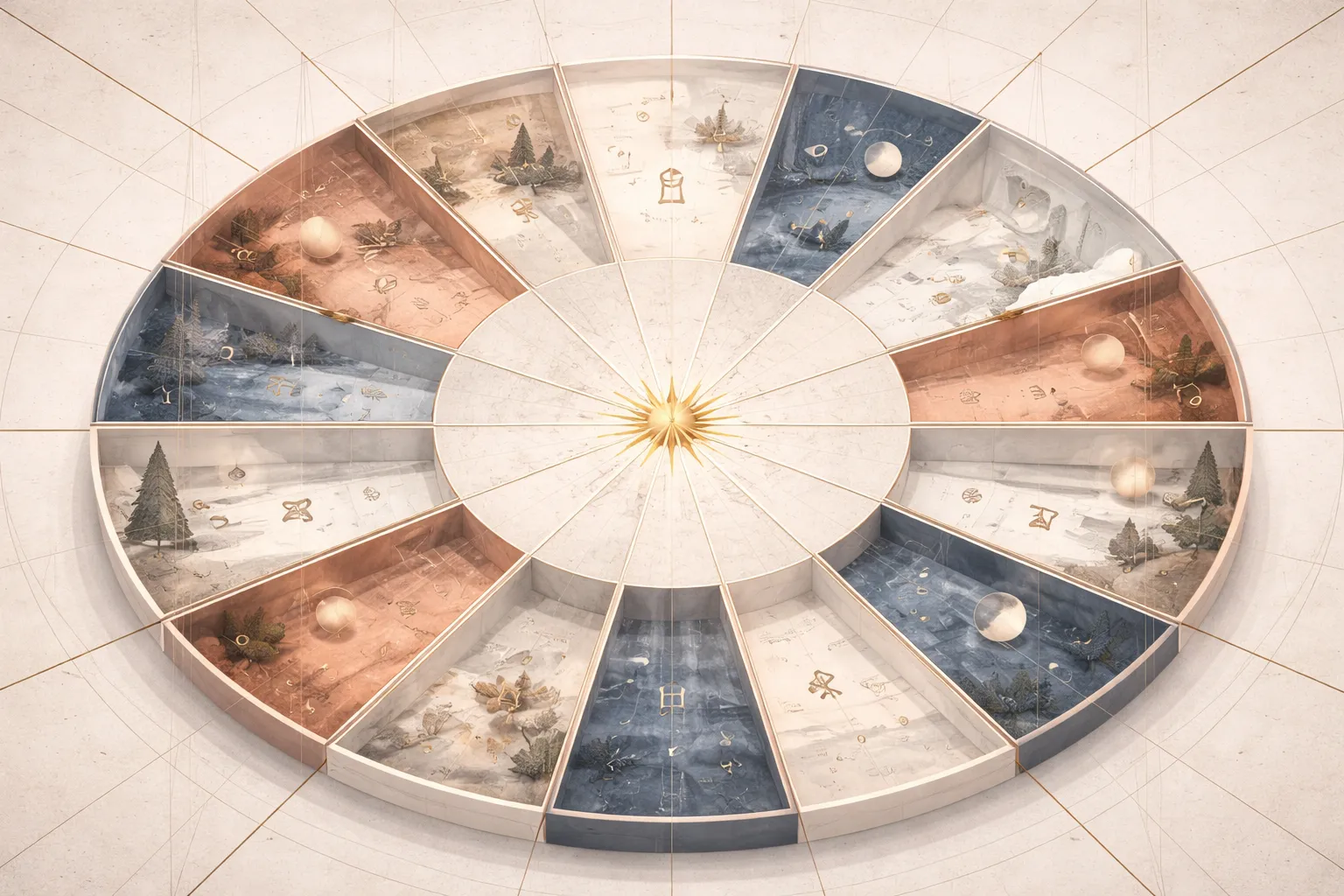
The houses are easier to understand when you read them as real-life zones: body, money, learning, home, love, work, partnership, intimacy, travel, career, community, and inner life. They do not describe personality in the same way signs do. They describe where experience tends to happen, where effort gathers, and which part of life becomes a main stage for development.
This shift matters because many people first learn houses as memorized keywords and then cannot use them. A house becomes much easier to read once you ask ordinary questions. Where does this person keep returning. Which area of life keeps demanding skill. What part of life becomes loud whenever a certain planet is activated. Houses make astrology concrete because they turn symbolism into lived context.
Planets are the actors, houses are the rooms
One of the cleanest ways to read a chart is to think of planets as the actors and houses as the rooms where the story is happening. Mars in the second house behaves differently from Mars in the seventh because the same energy is acting inside a different life arena. Venus in the tenth does not mean the same thing as Venus in the fourth because the relational and aesthetic impulse is being expressed through a different environment.
This is why houses change the lived meaning of a chart so dramatically. Two people can share the same Sun sign and still feel very different because their life emphasis is not landing in the same places. The houses tell you where the chart's energy gets tested, expressed, and made visible.
House emphasis tells you where life keeps asking for attention
A busy chart does not mean every part of life is equally loud. Usually a few houses hold more planets, and those houses become the stage where a lot of development happens. When several planets gather in one house, it usually means that area of life cannot remain background material. It becomes part of the person's main curriculum.
This is why two people with the same Sun sign can live that sign very differently. The houses change the context. A Leo Sun in the tenth may grow through visibility, reputation, and leadership. A Leo Sun in the fourth may grow through emotional security, family patterning, and the question of what kind of inner foundation can support a visible life.
- First house emphasis often feels identity-heavy and immediate.
- Fourth house emphasis turns attention toward roots, family, and emotional foundation.
- Seventh house emphasis makes partnership and mirroring central.
- Tenth house emphasis pushes growth through visibility, responsibility, and career direction.
Angular houses speak louder than background houses
The angular houses, first, fourth, seventh, and tenth, tend to speak the loudest because they are tied to the main axes of life. Identity, home, relationship, and direction are not subtle arenas. When a chart is strongly angular, life usually feels more immediate, visible, and externally consequential. The person may feel like they are constantly being asked to define themselves, build a foundation, navigate other people, or become publicly answerable for something.
By contrast, cadent and succedent houses matter deeply too, but they may speak with a different rhythm. Some are about refinement, maintenance, preparation, private process, or long-term development rather than immediate outer pressure. Knowing this helps you avoid reading every house with the same volume.
An empty house is not a missing life area
One of the most common misunderstandings is assuming an empty house means nothing happens there. That is not how houses work. An empty house simply means you are not carrying a natal concentration of planets in that area. The house is still active through its sign, its ruler, and any transits that move through it over time.
In practice, many important life events happen through empty houses. The key is not whether planets sit there natally, but how the house is ruled and how it is activated. This is why empty houses should be read with less anxiety. They are not dead zones. They are simply not the chart's loudest starting point.
Read the ruler if you want one layer deeper
After identifying the most emphasized houses, find the sign on each cusp and locate its ruler in the chart. The ruler connects one life area with another and gives the house a more specific interpretive route. If the seventh-house cusp is Taurus, Venus adds context to partnership questions. If the fourth-house cusp is Aquarius, Saturn—and Uranus in modern practice—adds context to home and private foundations.
This is often where charts become much more personal. The house may tell you the topic, but the ruler tells you how that topic moves. A tenth house ruled by Mercury will not behave like a tenth house ruled by Mars. A fourth house ruled by the Moon will not process stability the same way as one ruled by Saturn. House rulers keep the chart from becoming flat.
The same house can mean different things at different ages
Another reason houses are so rich is that they are developmental. The fourth house can describe your literal home, your childhood environment, your need for rootedness, or what emotional foundation you are trying to build for yourself as an adult. The tenth house can describe public role, but also the pressure of achievement, your relationship to authority, or what you want to be known for over time.
This is why a house interpretation should not be overly narrow. The symbolism often matures with the person. Houses show where life keeps returning, but the exact form of the lesson changes as the person changes.
How to actually use houses in a real reading
The most useful way to work with houses is simple. First identify which houses are most emphasized. Then look at which planets live there. Then read the rulers of those houses. After that, ask whether the same topics are reinforced through aspects, transits, or timing tools. This creates coherence. Instead of reading twelve separate life areas mechanically, you start seeing which areas of life are truly central to the chart.
That is when houses become far more than keywords. They become the map of where growth, conflict, visibility, relationship, work, privacy, belonging, and change keep becoming real.
Use the free synastry chart calculator for your own charts.
Compare two birth charts and see how Venus, Moon, Saturn, Lilith, house overlays, and other key contacts show up in your actual chart pair.