
How To Read Repeated House Emphasis
Trace house clusters, rulers, angles, and timing repetition to see when one life area genuinely organizes a chart.
In this article
In short
- When one life area keeps receiving the chart's weight
- Planet clusters show concentration of attention.
- The emphasized house often becomes a hub for other chart themes.
Repeated house emphasis is usually a structural theme, not a coincidence
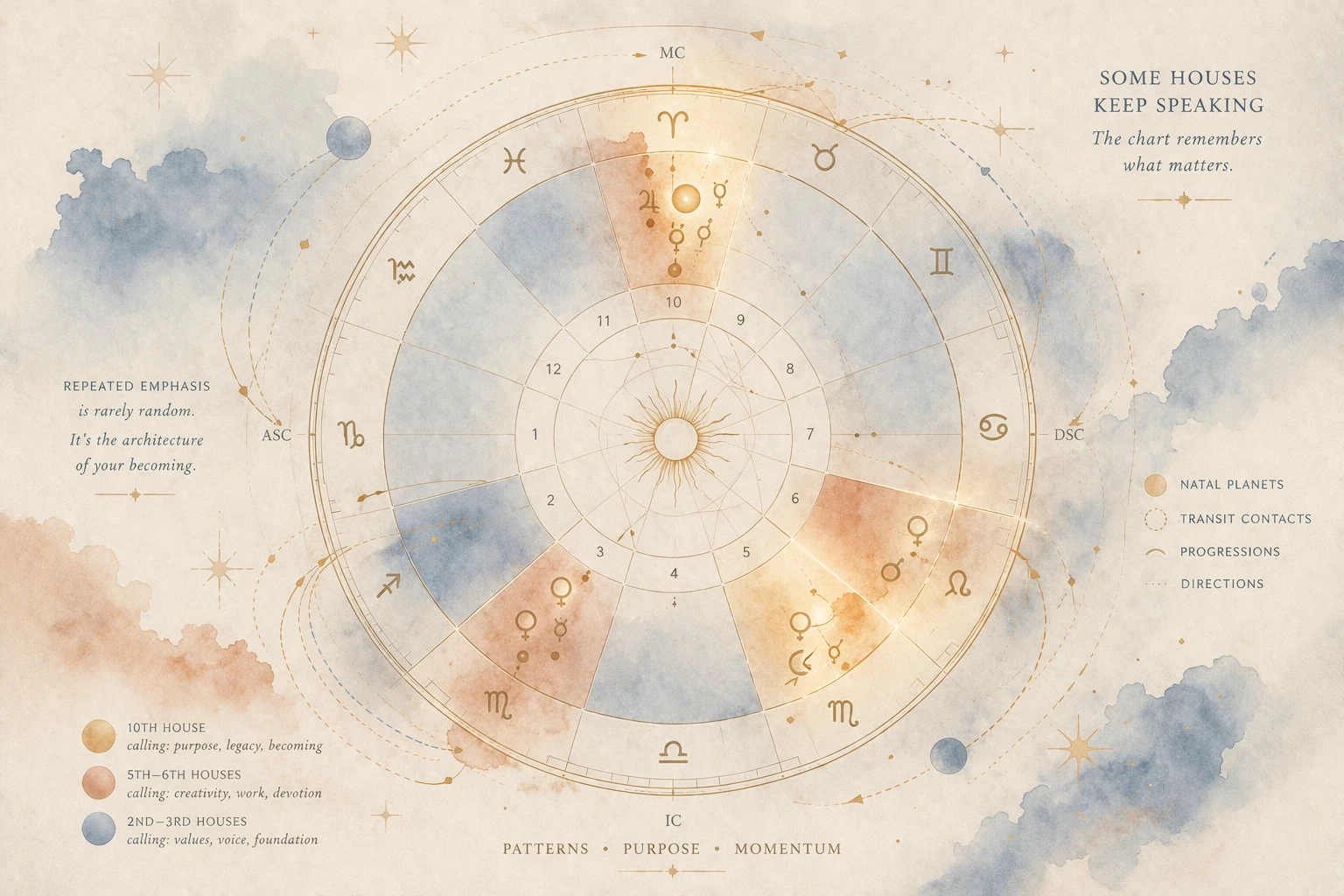
One of the fastest ways to make a chart feel coherent is to stop reading every house as equally loud. Real charts usually organize themselves around a few life arenas that carry much more repetition than others. This can happen through multiple planets in one house, a house ruler becoming central elsewhere, repeated aspects to that ruler, or several chart factors pointing back to the same part of life. When that happens, the house is not just populated. It is carrying structure.
This matters because people often underestimate repetition unless it looks obvious. They notice a stellium, but they miss quieter forms of house emphasis, like a house ruler on an angle or several important planets answering to the same house. The chart may be telling one story in several different ways, and repeated house emphasis is often how that story becomes visible.
A crowded house is only the beginning
The most obvious kind of emphasis is a cluster of planets in one house, but that is only one version. A house can also become loud if its ruler is angular, heavily aspected, conjunct a luminary, or repeatedly activated by other important chart factors. In other words, house emphasis is not just about bodies physically sitting there. It is about how much of the chart's weight keeps routing through that life area.
This is why two charts with the same number of planets in a house can still live that house very differently. In one chart, the cluster may be descriptive but not central. In another, the same house may dominate the entire chart because the ruler is also loud, the angles support it, and the main aspects keep feeding back into it.
- Planet clusters show concentration of attention.
- A strong house ruler can make a house loud even when it is not crowded.
- Repeated aspect ties can keep feeding one life area from multiple directions.
Repetition usually shows where life keeps demanding development
A repeated house is often the place where chart factors keep accumulating. It may describe an area that receives more attention, decisions, or consequence than average. A strong second-house emphasis may keep returning to resources, skill, and self-support. A strong seventh-house emphasis may organize more of the reading around negotiation, conflict, commitment, and one-to-one relationships.
This does not mean the emphasized house is always easy or always difficult. It means the house carries developmental weight. Even positive experiences there may feel important, because the chart keeps treating that area as one of the main classrooms of the life.
House repetition becomes clearer when you follow the rulers
One of the most underused techniques in chart reading is ruler tracing. If the ruler of the tenth house sits in the fourth, career and home may keep talking to each other. If the ruler of the seventh is conjunct Saturn in the first, relationships may shape identity and self-protection more than expected. Repeated house emphasis often becomes much more obvious once you stop looking only at occupancy and start following the chain of rulership.
This technique matters because some charts hide their priorities in plain sight. A house may not look crowded, yet the ruler of that house may be one of the loudest planets in the chart. In that case, the house still matters deeply. It is just being expressed indirectly rather than through obvious clustering.
The loud house is not always the favorite house
People sometimes assume a repeated house must describe what comes naturally or what they enjoy most. Sometimes it does. But just as often, repeated house emphasis marks where effort, tension, or unresolved growth keeps collecting. A strong sixth-house chart does not automatically mean someone loves routine. It may mean life repeatedly organizes itself around work, maintenance, health, usefulness, and adaptation because that is where the chart keeps having to build skill.
This is why house emphasis should be read with tone, not just topic. Which planets are involved. Is Saturn carrying the house. Is Venus softening it. Is Mars sharpening it. Is the ruler supported or under pressure. Repetition tells you where the life keeps happening. Tone tells you how that happening is usually lived.
Repeated houses can explain why one life area keeps affecting everything else
A truly emphasized house often behaves like a central hub. Decisions in that area spill outward into other parts of life. A person with strong fourth-house emphasis may find that home, family, and inner security affect vocation, health, and relationships more than expected. Someone with strong eleventh-house emphasis may discover that friendships, audiences, community, or long-range visions quietly influence work choices, identity, and emotional life.
This is one reason repeated house emphasis is so useful for synthesis. It keeps you from reading the chart as a set of disconnected parts. You begin to see where the chart's energy keeps collecting and from where it tends to spread.
- The emphasized house often becomes a hub for other chart themes.
- Major life decisions may keep routing through that area first.
- A loud house can explain why one topic keeps affecting unrelated parts of life.
How to tell whether the emphasis is truly major
A house is usually major when more than one layer keeps confirming it. The house is crowded, the ruler is loud, the angles echo it, and the same topic appears through major aspects or repeated sign emphasis. If only one of those signals is present, the house may still matter, but it may not dominate the chart. If several are present, you are probably looking at one of the main organizing themes of the life.
This is where reading order helps. Start with occupancy, then follow the ruler, then notice whether the house connects to angles, luminaries, or chart ruler dynamics. By the time you finish that sequence, repeated house emphasis usually becomes much easier to judge without exaggeration.
Why this technique changes the whole chart
Repeated house emphasis helps you stop reading a chart as a pile of separate facts. It shows where the chart is concentrated, where life keeps returning, and which area of experience quietly organizes the rest. That makes every other interpretation more accurate, because placements stop floating without context. You can see which symbolism belongs to the core of the chart and which symbolism is secondary detail.
In practice, this is one of the techniques that makes astrology feel less random and more alive. Once you know where the house emphasis truly sits, the chart begins to read like a pattern instead of a catalog. And pattern is where real interpretation starts.
See how this pattern shows up in your actual birth chart.
Open your chart and look at your planets, houses, angles, and aspects in one place instead of reading the pattern in the abstract.