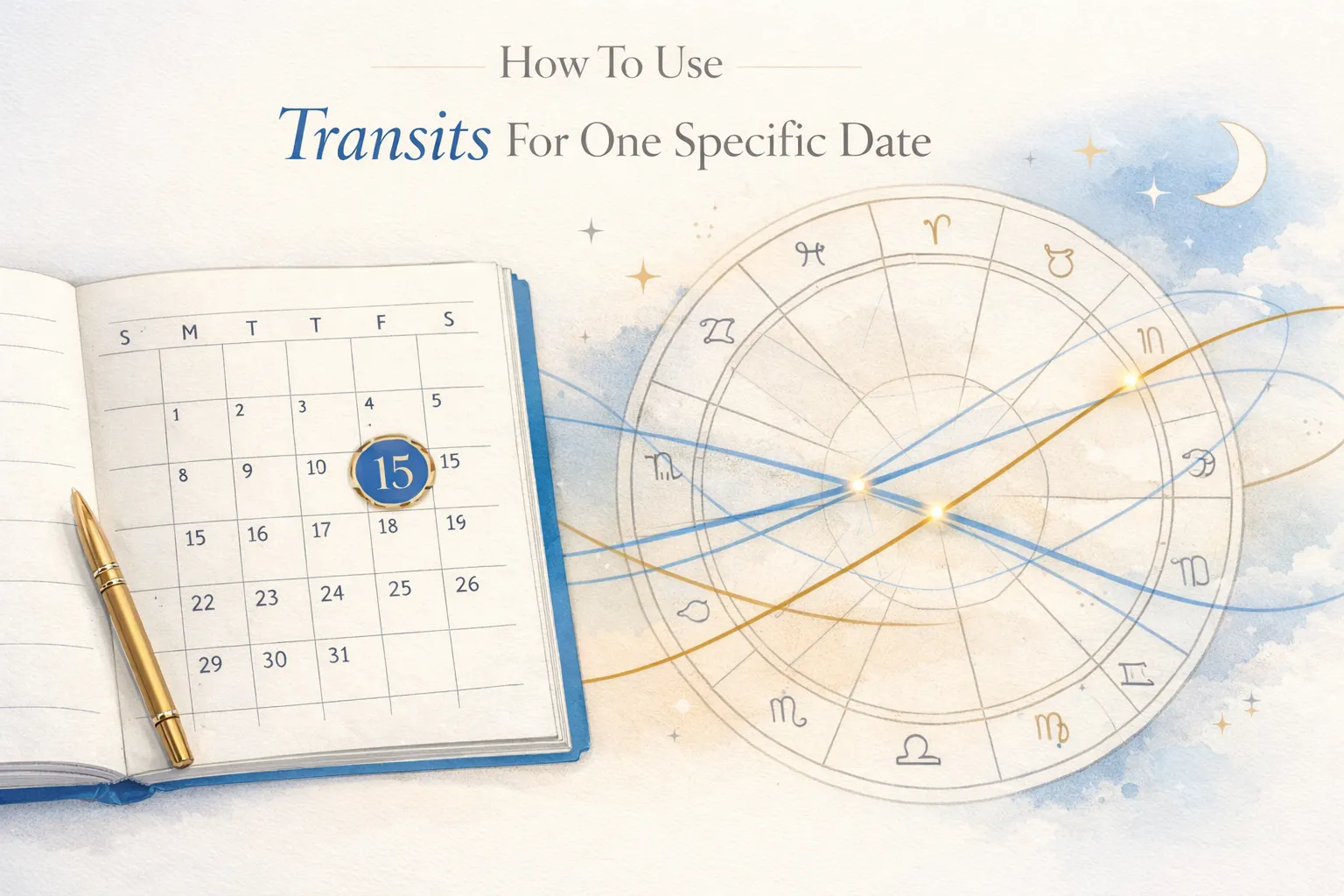
How To Use Transits For One Specific Date
A method for comparing one date with a birth chart while separating personal contacts from background sky.
In this article
In short
- One date, one question, clear timing
- Moon and Mars contacts often feel immediate and lived in the body.
- Fast planets often describe mood, pace, and event texture.
Use the day as a narrow question
Date-based transits are strongest when the question is narrow. Instead of asking what the whole future means, ask what is activated on this day and whether the sky is flowing, pressing, or exposing something. A single date is not a complete life forecast. It is a timing lens. It helps you understand the quality of a moment, the type of pressure present, and the natal part of you that is being called forward.
This keeps the reading honest and much more useful for planning, reflection, or timing decisions. A good date-based transit reading is not about predicting everything. It is about recognizing whether the day supports initiative, asks for caution, intensifies emotion, or brings a clearer confrontation with a pattern that was already building.
Start with the tightest orbs, but do not stop there
The most immediate transits are usually the ones with the smallest orb. They are not always the most life-changing, but they are often the most audible in the moment. That is why a compact transit table sorted by orb is so effective. It lets you see what is closest before the page becomes a wall of astrology language.
Still, orb alone is not the full story. A very tight transit Moon trine Venus may describe the mood of the day. A wider transit Saturn to your Sun or Pluto to your Moon may describe the deeper process behind the week, month, or year. The best way to read one date is to start with the smallest orbs, then ask which of those contacts are short weather and which belong to a larger chapter.
- Moon and Mars contacts often feel immediate and lived in the body.
- Saturn contacts slow, structure, test, or clarify.
- Jupiter contacts expand, open, or exaggerate.
- Neptune contacts soften boundaries and can reduce clarity.
Match the transit with the natal target
A transit never means much in isolation. You need to ask what natal planet or angle is being touched and what that natal symbol already represents in your chart. Transit Mars to natal Moon feels different from transit Mars to natal Saturn because the natal target changes the experience. The sky may describe the timing, but the natal chart describes the area of life and the emotional tone of what that timing will feel like.
This is where many transit readings go shallow. They describe the transiting planet but ignore the natal placement being activated. If Saturn touches your natal Venus, the experience may center around relationships, self-worth, resources, or emotional pacing. If Saturn touches your natal Mercury, the same slowing effect may land in decision-making, communication, study, contracts, or mental pressure. The transit is only half the sentence until the natal target completes it.
Read status before you dramatize the event
It helps to note whether a transit is applying, exact, or separating. Applying aspects often describe what is building. Exact aspects describe peak contact. Separating aspects often show what is already unfolding and beginning to teach you what the transit was about. This simple distinction prevents overreaction. Not every strong-looking transit is equally active in the present moment, and not every tense contact means something is going wrong.
Sometimes the most helpful thing a one-date transit reading can do is tell you whether you are at the beginning, middle, or release phase of a process. An applying contact may feel like anticipation or gathering pressure. An exact contact may feel like exposure, peak visibility, or the point of no longer being able to ignore the issue. A separating contact may still feel active, but the lesson is often becoming easier to name.
Decide whether the transit is weather or development
One of the most useful distinctions in astrology is the difference between passing weather and developmental timing. Fast transits from the Moon, Mercury, Venus, and Mars often shape a day without defining a life chapter. Slower contacts from Saturn, Uranus, Neptune, or Pluto often describe a longer process even if you are checking them on one particular date.
This matters because users often overestimate fast tension and underestimate slow restructuring. A sharp Moon-Mars day can feel loud, but it may pass quickly. A Saturn square to your Sun may feel less dramatic in one moment, yet it can describe the deeper reality shaping that entire season. A good one-date reading asks both questions at once. What is loud today. And what longer process is this day sitting inside.
- Fast planets often describe mood, pace, and event texture.
- Outer planets often describe the chapter underneath the day.
- Angle contacts and chart ruler contacts deserve extra attention.
If several transits are active, look for a common theme
A real chart rarely gives only one clean signal. Several transits may be active on the same date, and the page can quickly look crowded. Instead of trying to interpret everything equally, look for repetition. Are several contacts pointing toward emotional sensitivity, relationship realism, urgency, exposure, or confidence. When the same theme appears through different planets, the reading becomes clearer.
For example, if Saturn is contacting Venus while the Moon is moving through the seventh house and a Mars aspect is hitting your Descendant, relationship themes are probably louder than work themes even if other smaller transits also appear. Pattern beats novelty here. Repetition tells you what the day is really organized around.
What makes one-date transits genuinely useful
Use the result to make one proportionate adjustment: allow more time, move the difficult conversation, protect focus, or proceed as planned with a clearer sense of the pressure involved. The value is not knowing exactly what will happen. It is identifying what deserves attention without turning the entire day into a forecast.
- What is the day's clearest theme?
- Which natal planet, angle, or house is carrying it?
- Is the contact brief weather or part of a longer process?
- What small planning decision becomes clearer with that context?
See how a specific date activates your chart.
Open your transit chart and check which exact contacts are active for the date you want to understand more clearly.