
Daily Sky vs Personal Transits: What Is The Difference?
When the general sky is useful, when a natal comparison adds precision, and why the same transit does not land identically for everyone.
In this article
In short
- Collective weather and personal activation
- Use Daily Sky for collective mood and fast orientation.
- Daily Sky: collective atmosphere, planetary positions, and broad orientation.
Daily sky is collective, personal transits are specific
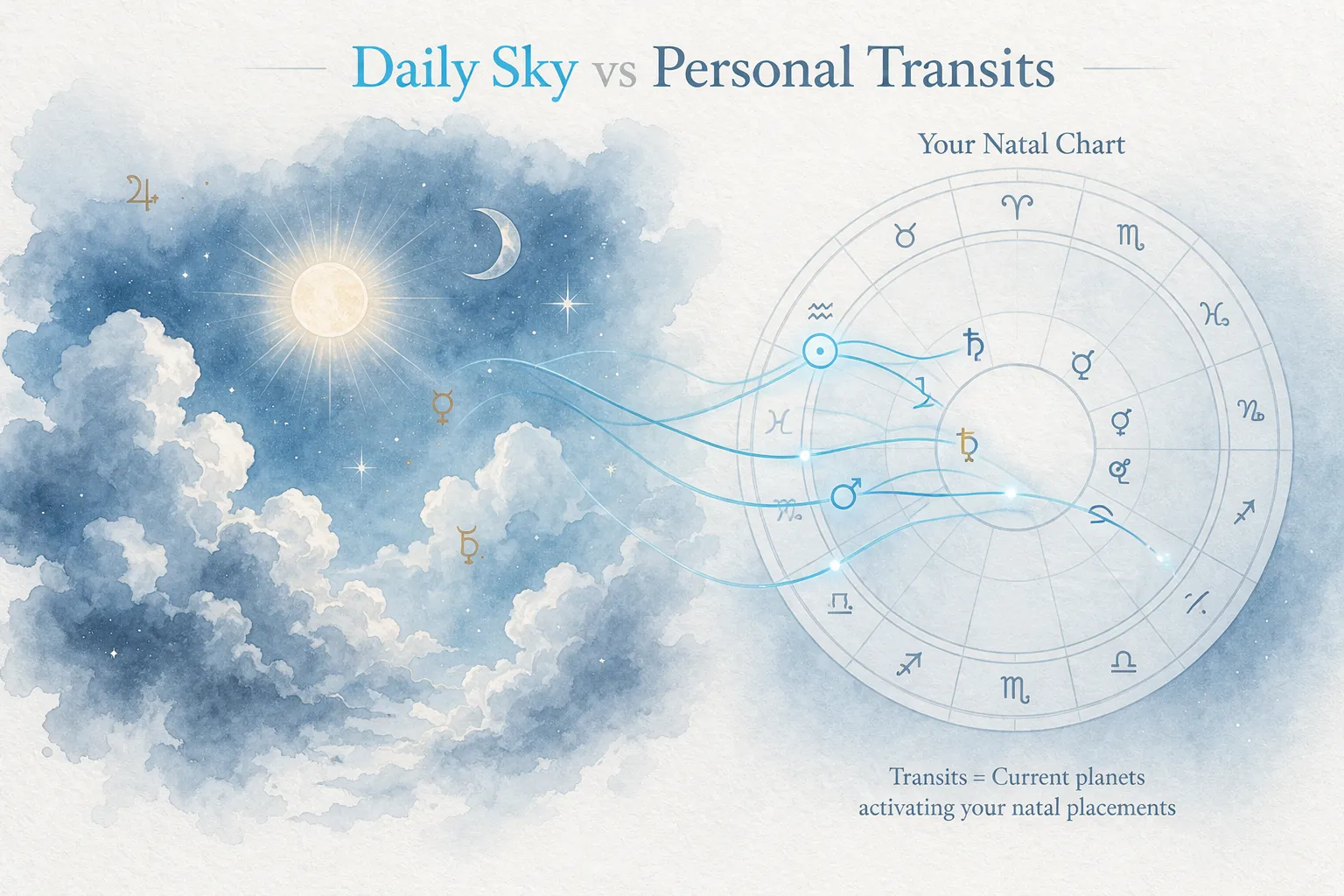
Daily sky reading describes the collective atmosphere. It tells you the shared weather of the day: whether the sky is tense, emotionally loud, smooth, confrontational, reflective, or open. Personal transits take that same sky and compare it to your natal chart, which means they show whether the weather is actually hitting something important for you. This is the difference between general conditions and personal activation.
That difference matters because a dramatic-looking sky does not automatically mean your personal day is dramatic. Likewise, a relatively quiet collective sky can still matter deeply if a transit is making an exact contact to your Sun, Moon, angle, or another sensitive natal point. The weather may be shared, but its impact is not evenly distributed.
Use Daily Sky when you want orientation fast
Daily Sky is the better tool when you want quick orientation. It is ideal for asking simple questions like: what is the mood of the day, is the overall sky supportive for focused work, difficult conversations, emotional processing, or slowing down, and what kind of collective pace are people likely moving through. It is a fast dashboard for the social and emotional climate.
This makes it especially useful when you are checking in without a heavy interpretive agenda. Daily Sky helps users build a reading habit, spot strong days, and understand broad pressure without needing to open a fully personalized chart every time. It is less about personal fate and more about situational awareness.
- Use Daily Sky for collective mood and fast orientation.
- Use it when you want rhythm, not personal precision.
- It works well for habit-building and general timing.
Use personal transits when the date is actually about you
If you are checking a specific date for yourself, personal transits are stronger. They tell you whether the day is activating your own chart and which natal symbol is receiving the contact. That changes everything. A Mars square in the sky means one thing collectively. Mars square your natal Moon means something much more immediate and personal. It tells you where the day is landing in your actual emotional or practical experience.
Personal transits are also better when you are timing decisions, reading emotional sensitivity, or trying to understand why a day feels louder than it looks. They explain not only the sky, but your point of contact with the sky. That is why they are usually the better choice for appointments, difficult conversations, launches, meaningful trips, or days you already suspect are carrying more weight.
Why people often confuse the two
People often mistake Daily Sky for a personal forecast because collective astrology can feel accurate in a broad way. If the sky is tense, many people will feel some version of that tension. But personal transits show whether the tension is actually plugging into your chart. Without that layer, a general sky reading can be emotionally true but personally imprecise.
The reverse also happens. Someone may ignore the collective sky because their personal chart looks quiet, but the shared atmosphere still affects environment, mood, timing, and the people around them. The difference is not whether one matters and the other does not. The difference is where the emphasis lands.
Use both when you want the cleanest reading
The most useful workflow is often simple: check Daily Sky first for the collective backdrop, then check personal transits if the date matters. This gives you context before detail. You understand the social and emotional climate of the day, and then you see whether your chart is actually being pressed, opened, or highlighted by it. Daily Sky explains the room you are walking into. Personal transits explain what in you is responding to that room.
That sequence prevents confusion. A challenging collective sky may not be your most important personal day. A fairly mild collective sky may still coincide with a major exact transit to your natal chart. Put together, the two tools create a reading that feels both broader and more accurate.
When Daily Sky is enough and when it is not
Daily Sky is usually enough when you want mood, rhythm, and light guidance. It works well for people who want a daily check-in, a sense of timing, or a brief read on whether the day feels sharp, soft, pressured, or flowing. It is not enough if you are asking whether this date is personally significant for you. That question belongs to personal transits, because significance depends on contact with your own natal chart.
If the question involves decisions, emotional vulnerability, or a date you already know matters, personal transits are the cleaner tool. If the question is simply what kind of sky everyone is under, Daily Sky is often exactly enough.
How to read them without overcomplicating your life
Choose the view from the question you have, not from whichever chart looks more dramatic. Daily Sky is enough when you want shared context. Open personal transits when a specific date, recurring feeling, or decision needs to be compared with your natal chart.
- Daily Sky: collective atmosphere, planetary positions, and broad orientation.
- Personal transits: exact natal contacts, individual timing, and a defined question.
See how a specific date activates your chart.
Open your transit chart and check which exact contacts are active for the date you want to understand more clearly.