
How To Tell Whether A Transit Is Triggering A Natal Promise
Use natal structure, timing repetition, and exact contacts to judge whether a transit activates an existing theme or adds temporary emphasis.
In this article
In short
- Timing works best when it is rooted in the natal chart
- Natal rulers carry more weight than background planets.
- Atmosphere often feels loud but leaves little permanent trace.
A transit can only wake up what the natal chart can actually hold
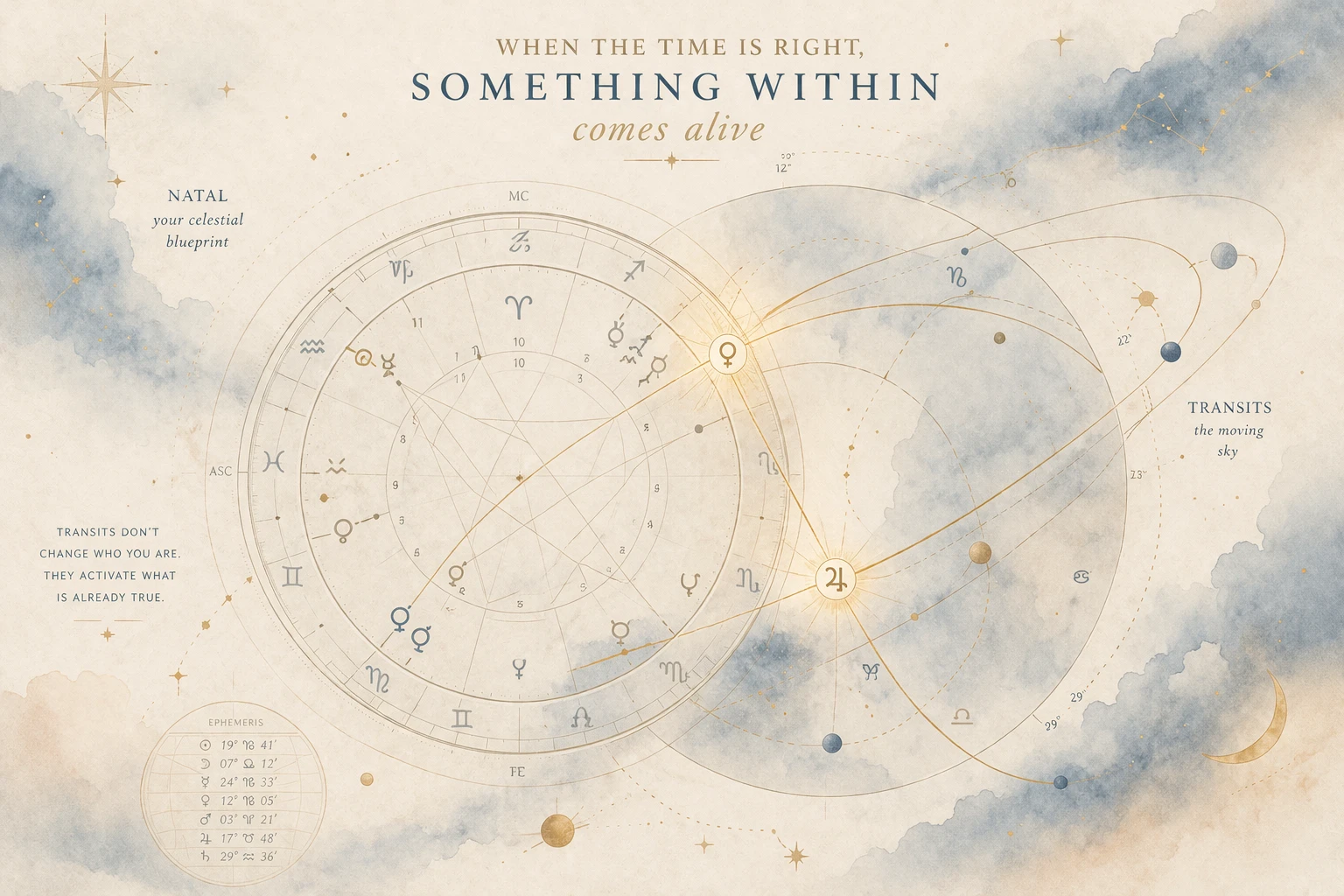
One of the most useful ideas in serious timing work is natal promise. The phrase does not mean fate in a rigid or theatrical sense. It means the natal chart already contains certain themes, capacities, tensions, and developmental pathways. Transits do not invent those themes from nothing. They time, intensify, expose, or accelerate material that the birth chart already makes possible.
This matters because people often read transits too literally. They see one strong-looking transit and assume it must produce a specific event. A much cleaner method is to ask whether the transit is activating a real natal pattern. If the natal chart already shows relationship change, visibility pressure, relocation themes, career restructuring, or emotional reorganization as live material, the transit may genuinely trigger it. If not, the same transit may describe mood or atmosphere more than an event.
Start by locating the natal pattern before you read the timing
The first step is always the natal structure. What does the natal planet, house, angle, or ruler already signify in this chart. If transit Saturn is contacting natal Venus, that is not enough by itself. You need to ask what Venus already does in the natal chart. Is Venus the ruler of the seventh house. Is it angular. Is it heavily aspected. Does it already carry themes of commitment, worth, finance, or relational pacing. Without that context, the transit stays generic.
This is why better transit interpretation often starts by stepping backward. Before you ask what is happening now, ask what the chart has always been capable of emphasizing. A transit is much more likely to trigger a natal promise when it is hitting a central natal function, not a peripheral point that has very little structural relevance.
- Natal rulers carry more weight than background planets.
- Angular natal planets are easier for transits to make visible.
- Repeated natal themes are more likely to time into lived events.
Repetition in the natal chart is one of the strongest clues
A true natal promise is rarely shown by one isolated symbol. It is usually repeated. A career-heavy chart may show a strong tenth house, a prominent Saturn, an angular Sun, or repeated Capricorn symbolism. A relationship-heavy chart may show loaded seventh-house rulers, Venus emphasized, angle involvement, or strong one-to-one house activation. Repetition tells you that the theme belongs to the architecture of the life, not just to one interesting placement.
When a transit hits a repeated natal theme, timing becomes more believable. If several natal indicators already point toward one life topic and a transit directly activates the ruler, angle, or clustered house carrying that topic, the transit is more likely to coincide with concrete development. Repetition is one of the clearest ways to separate genuine activation from interpretive reach.
Transits to rulers, angles, and concentrated houses often trigger the promise faster
Not every natal point is equally sensitive. Contacts to the chart ruler, luminaries, Ascendant, Midheaven, Descendant, IC, or a house ruler that carries a major topic usually trigger the chart more directly. The same is true when a transit enters or aspects a house with strong natal concentration. These contacts tend to move quickly from symbolism into lived relevance because they touch the organizing points of the chart.
This is where many transit readings become much cleaner. Instead of reading everything, you prioritize the contacts most capable of activating the chart's structure. A transit to an exact natal angle or an important ruler may matter more than several other aspects combined, because it has a direct route into a theme the chart is already built to express.
You usually need agreement from more than one timing layer
A transit is more convincing when it is not working alone. If a strong transit is also echoed by a solar return, profection, progressed emphasis, or eclipse axis, the argument for activation gets stronger. This does not mean every event needs four layers of confirmation. It means the more serious the claim, the more useful timing agreement becomes.
For example, a transit to natal Venus is one thing. A transit to natal Venus during a seventh-house profection year, while the solar return also emphasizes the seventh house, is much harder to dismiss as passing weather. Agreement between timing systems is often what turns a plausible reading into a durable one.
A transit can be real without being literal
Even when a transit is clearly triggering natal promise, it does not always manifest in the most literal or dramatic way. A natal promise around partnership does not guarantee marriage. It may time a serious conversation, a shift in expectations, a defining meeting, or the end of a stale relational pattern. A career promise does not guarantee promotion. It may show increased visibility, a heavier workload, clearer ambition, or a structural decision that changes the next year.
This is why the phrase natal promise should make a reading more precise, not more rigid. The chart shows the field of possible expression. The transit times pressure, movement, or opening inside that field. You still have to read the symbolism proportionally instead of forcing one transit into one event script.
How to tell the difference between activation and atmosphere
A transit is more likely to be atmosphere when it contacts less central natal points, lacks repetition, has little support from other timing layers, or describes a theme the chart barely emphasizes. It may still feel noticeable, but it does not necessarily mark a durable turning point. By contrast, activation usually looks more concentrated. The transit is exact or applying, the natal target is central, the theme is repeated in the natal chart, and at least one other timing layer agrees.
Once you learn that distinction, transit work becomes calmer and more accurate. You stop assuming every intense week must be destiny, and you stop overlooking the slower periods that are clearly reorganizing your life because they arrive without cinematic drama.
- Atmosphere often feels loud but leaves little permanent trace.
- Activation usually hooks into natal structure and repeats across systems.
- Exactness matters, but exactness without natal relevance is still limited.
Why natal promise protects timing from exaggeration
The real value of natal promise is proportion. It forces timing work to stay accountable to the actual chart instead of drifting into projection. That makes astrology less sensational and more useful. You are not asking what any transit could theoretically mean in a vacuum. You are asking what this transit is capable of awakening in this specific chart at this specific time.
That shift changes everything. It keeps you from overpredicting, but it also helps you recognize when a transit really does deserve respect. When the sky is waking up a theme the natal chart has been carrying all along, timing becomes much more than daily weather. It becomes a readable moment in a larger life pattern.
See how this pattern shows up in your actual birth chart.
Open your chart and look at your planets, houses, angles, and aspects in one place instead of reading the pattern in the abstract.