Moon Sign Meaning: How to Find Yours and Read All 12 Zodiac Signs
Learn what a Moon sign means, why birth time can change the result, and how to read the Moon through all 12 signs, its house, phase, and closest aspects.
In this article
In short
- The Moon’s sign is one part of a moving natal story
- Use the recorded local birth time rather than a rounded family estimate when possible.
- Sun: identity, vitality, intention, and creative direction.
What a Moon sign is
Your Moon sign is the zodiac sign occupied by the Moon at your birth moment. In natal astrology, it is used to describe instinctive responses, emotional pacing, familiar comfort patterns, memory, and what helps a person feel settled enough to respond rather than simply react. It is not a second Sun sign and it does not replace the rest of the birth chart.
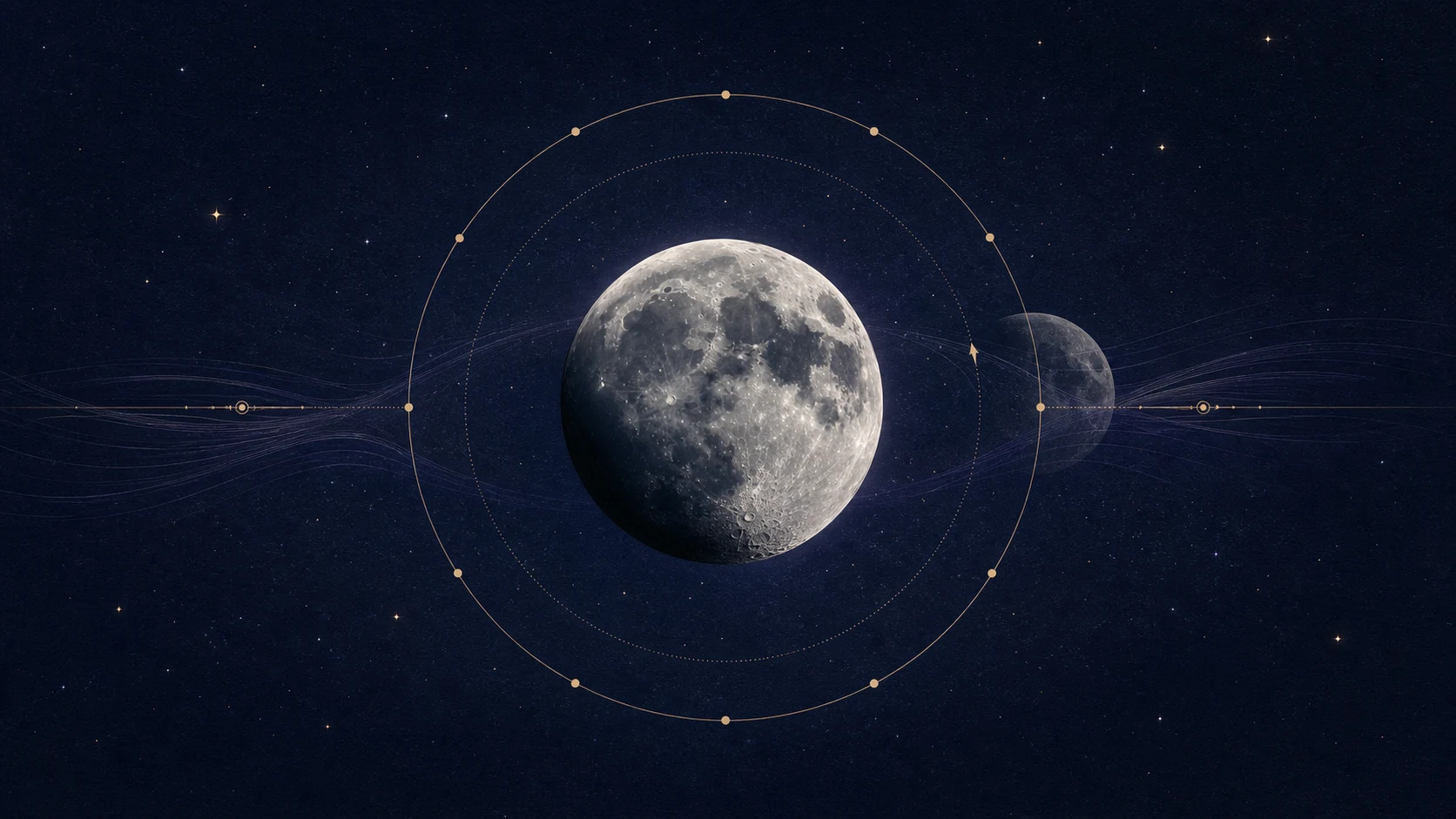
The Moon moves quickly, changing signs about every two and a half days. That is why people born on the same calendar date can have different Moon signs, especially when the Moon crossed a sign boundary that day. The exact degree matters too: it determines the Moon’s closest aspects and, with an accurate birth time and location, the natal house in which it falls.
Astrology is an interpretive tradition rather than a scientifically validated personality test. A Moon placement can provide a useful symbolic language, but it cannot diagnose mental health, prove attachment style, or predict how someone will behave.
How to find your Moon sign accurately
A Moon sign calculator needs your birth date and, whenever possible, your local birth time and city. The calculator converts local time to the correct universal time, calculates the Moon’s zodiac longitude, and then identifies its sign and degree. The city also allows the chart to calculate houses and account for the time-zone rules in effect when you were born.
If the Moon stayed in one sign throughout your birth date, an unknown time may not change the sign. If it entered a new sign that day, however, a noon estimate can return the wrong result. An accurate calculator should flag that uncertainty instead of presenting one sign as certain. Time also matters when the Moon is close to a house cusp, an angle, or a narrow aspect.
For a useful result, look beyond the sign name. Record the exact degree, house, lunar phase, ruler of the Moon sign, and the tightest major aspects. Those details explain why two people with the same Moon sign may process experience very differently.
- Use the recorded local birth time rather than a rounded family estimate when possible.
- Check whether the Moon changed signs on your birth date if the time is unknown.
- Keep the zodiac system consistent: tropical and sidereal charts will often show different signs.
- Treat the degree, house, phase, and close aspects as part of the result—not optional decoration.
Moon sign, Sun sign, and Rising sign do different jobs
The Sun is associated with conscious identity, vitality, authorship, and the direction a person is learning to inhabit more deliberately. The Moon describes a more immediate layer: what feels familiar, how emotion is registered, and which conditions make it easier to recover a sense of steadiness. The Rising sign marks the beginning of the house system and describes the chart’s initial orientation toward the world.
These placements can speak in very different tones. Someone with a Leo Sun, Capricorn Moon, and Pisces Rising may be creatively expressive at the center, more controlled and practical when vulnerable, and unusually receptive on first contact. None of those factors cancels the others. They describe different functions operating in one chart.
This distinction also prevents a common reading mistake. A Moon in a reserved sign does not mean the person lacks feeling, just as a Moon in an expressive sign does not guarantee emotional openness in every situation. The house, aspects, and the condition of the Moon’s ruler show where the sign’s style becomes easier, guarded, or more complicated.
- Sun: identity, vitality, intention, and creative direction.
- Moon: instinct, emotional rhythm, familiarity, and comfort needs.
- Rising sign: first orientation, visible approach, and the structure of the houses.
Moon sign and Moon phase are not the same thing
The Moon sign tells you where the Moon was in the zodiac. The natal Moon phase describes the angular relationship between the Sun and Moon. A Taurus Moon can be born at a New Moon, First Quarter, Full Moon, or any phase between them; each phase changes the relationship between conscious direction and instinctive response.
The sign supplies the Moon’s style. The phase describes a developmental rhythm: beginning, building, testing, culmination, distribution, revision, or release. Reading both prevents the Moon from becoming a static list of traits. A waxing Taurus Moon and a waning Taurus Moon share a sign, but they do not organize initiative and reflection in exactly the same way.
Fire Moon signs: Aries, Leo, and Sagittarius
Fire Moons tend to process feeling through movement, expression, directness, or a renewed sense of possibility. Emotion often needs somewhere to go. The shared element does not make the three signs identical: Aries acts, Leo gives feeling a personal form, and Sagittarius looks for space and meaning.
- Moon in Aries: responses tend to arrive quickly and clearly. This Moon often settles better after honest action, movement, or a direct acknowledgment of what is wrong. Frustration grows when every reaction must be softened before it is even understood. Mars, the sign ruler, shows where the emotional charge goes and whether it is expressed, delayed, or redirected.
- Moon in Leo: feeling becomes easier to hold when it can be expressed with warmth, dignity, and personal authorship. Appreciation matters, but the deeper need is often to know that the heart has a visible place in the room. The Sun’s sign and house show where this Moon seeks a stable center rather than constant applause.
- Moon in Sagittarius: emotional space expands through perspective, candor, learning, humor, or movement toward a wider horizon. Confinement can make a difficult feeling seem even larger. Jupiter shows where meaning and possibility are restored, while its condition reveals when optimism becomes avoidance.
Earth Moon signs: Taurus, Virgo, and Capricorn
Earth Moons usually need something tangible: time, continuity, a workable plan, physical comfort, or a task that restores order. Their responses can look composed from the outside, but steadiness should not be mistaken for emotional simplicity.
- Moon in Taurus: the Moon is traditionally exalted here. Predictable rhythms, sensory comfort, trusted people, and enough time to adjust can help feeling settle into the body. The challenge is knowing when stability has become resistance to a necessary change. Venus shows what this Moon values and how comfort, attachment, and pleasure are negotiated.
- Moon in Virgo: emotion is often processed by observing details, naming what can be improved, and making the situation more manageable. Practical care can be a genuine love language. Under strain, analysis may continue long after it has stopped helping. Mercury shows whether words, routines, work, or problem-solving provide clarity or simply more noise.
- Moon in Capricorn: this Moon may organize feeling through restraint, responsibility, and evidence that life remains manageable. Trust often grows through consistency rather than immediate disclosure. Saturn shows where emotional authority develops slowly and where self-control needs to make room for support, rest, and ordinary dependence.
Air Moon signs: Gemini, Libra, and Aquarius
Air Moons tend to find room around feeling through words, comparison, conversation, or a change in perspective. Thinking about an emotion is not automatically the same as avoiding it. The question is whether language creates contact or keeps the experience permanently at a distance.
- Moon in Gemini: emotional movement often begins with naming, questioning, and hearing more than one version of the story. Variety can refresh this Moon, but too many explanations may fragment the original feeling. Mercury shows how quickly inner experience becomes language and whether communication brings connection or distraction.
- Moon in Libra: balance is sought through reciprocity, proportion, and an environment where more than one person’s reality can be considered. Conflict may be delayed while the Moon searches for the fairest response. Venus shows what kind of relationship feels restorative and when harmony starts costing too much honesty.
- Moon in Aquarius: perspective and autonomy help this Moon process what feels overwhelming. It may need time outside the immediate emotional field before returning with a clearer response. Saturn, the traditional ruler, shows where distance becomes mature perspective and where it hardens into isolation; Uranus can add a more abrupt, unconventional rhythm.
Water Moon signs: Cancer, Scorpio, and Pisces
Water Moons register tone, trust, memory, and emotional atmosphere readily. They may need privacy or a reliable container before explaining what they feel. Sensitivity is not the same as passivity: Cancer protects, Scorpio controls access, and Pisces absorbs and connects.
- Moon in Cancer: the Moon rules Cancer, so lunar themes are especially direct. Belonging, continuity, care, and a home base can strongly affect emotional steadiness. This Moon remembers atmosphere as much as events. Its house and aspects show whether care circulates freely or becomes a role that leaves little room for personal need.
- Moon in Scorpio: feeling tends to be concentrated, private, and alert to what is not being said. Trust is rarely casual. Emotional honesty can be restorative, while forced disclosure usually is not. Mars, the traditional ruler, shows how this Moon protects itself and where intensity can become decisive action rather than permanent vigilance.
- Moon in Pisces: boundaries between personal feeling, imagination, and the surrounding atmosphere may be more permeable. Solitude, art, sleep, music, or spiritual practice can provide a place for impressions to settle. Jupiter shows where faith and meaning help; Neptune adds nuance around sensitivity, idealization, and the need for clearer limits.
House placement shows where the Moon becomes personal
The sign describes how the Moon operates; the house shows where its patterns become especially visible. A third-house Moon may process experience through conversation, writing, siblings, or the immediate environment. A sixth-house Moon can tie steadiness to routines, usefulness, work, and the condition of everyday life. A tenth-house Moon may find that public roles and changing expectations have a direct emotional impact.
House placement depends on birth time and location. If the time is unknown, it is better to leave the house unconfirmed than to build an interpretation on a noon chart. If the Moon sits close to a cusp, compare the recorded time and house system before deciding that one house description is definitive.
Read the house as a setting, not a verdict. Moon in the seventh does not guarantee marriage, and Moon in the twelfth does not prove secrecy or suffering. The house identifies a field in which lunar needs, habits, and changes may be easier to notice.
Aspects and the sign ruler change the reading
Start with the closest major aspects to the Moon. Saturn contacts can add caution, delay, or a strong need for emotional reliability. Uranus may quicken the rhythm and increase the need for freedom. Neptune can heighten permeability and imagination. Pluto may intensify questions of trust and control. Mercury can help translate feeling into language, while Venus or Jupiter may provide more accessible routes to ease and connection.
No aspect is automatically good or bad. A trine can describe an ability that runs so easily it is taken for granted; a square can become highly skillful because it demands repeated adjustment. Orb matters. A close contact generally deserves more attention than a long list of wide aspects.
Then follow the ruler of the Moon sign. For an Aries Moon, inspect Mars; for Libra or Taurus, inspect Venus; for Gemini or Virgo, Mercury. Its sign, house, and aspects connect the Moon to the rest of the chart. A Taurus Moon with Venus in the ninth house tells a different story from one with Venus in the twelfth.
Why two Moon sign calculators may disagree
Different results usually have a technical explanation. One calculator may use the tropical zodiac and another the sidereal zodiac. The entered time may be rounded, the time zone may be wrong, or historical daylight-saving rules may have been handled differently. A Moon close to a sign boundary makes even a small input difference more visible.
Compare the birth data first, then the zodiac system and exact lunar degree. If both calculators use the same system and data, the displayed sign should normally agree. House differences can still occur because calculators may use different house systems. Do not choose the result that sounds more flattering; identify the method that produced it.
- Confirm date, local time, city, and time zone.
- Check tropical versus sidereal zodiac.
- Compare the Moon’s exact degree, not only the sign label.
- For a house disagreement, compare the house system and proximity to a cusp.
A clean way to read your Moon sign result
Begin with the Moon sign and exact degree. Add the natal house only if the birth time is reliable. Then note the lunar phase, the sign ruler, and the two or three closest major aspects. This order keeps the reading specific without turning every minor contact into a separate personality claim.
Suppose the result is Moon in Taurus in the sixth house, square Saturn, during a waxing phase. Taurus describes the need for steadiness and embodied continuity; the sixth house brings that need into routine and daily work; Saturn adds pressure around reliability or control; the waxing phase emphasizes building and development. The interpretation comes from the combination, not from repeating a Taurus trait list.
Finally, look for repetition elsewhere in the chart. If the Moon, its ruler, and several planets all emphasize the same element or houses, the theme deserves more weight. If the Moon sign seems unlike the rest of the chart, keep the difference. A birth chart is a structure of competing needs, not a test that requires every placement to say the same thing.
See how this pattern shows up in your actual birth chart.
Open your chart and look at your planets, houses, angles, and aspects in one place instead of reading the pattern in the abstract.
Frequently asked questions
What is my Moon sign?
It is the zodiac sign occupied by the Moon at your birth moment. A calculator can show the sign, exact degree, natal house, lunar phase, ruler, and closest aspects.
Can I find my Moon sign without a birth time?
Sometimes. If the Moon remained in one sign throughout your birth date, the sign may be stable. If it changed signs that day, the time is needed to know which result is yours. The house and angles also remain uncertain without an accurate time.
How often does the Moon change zodiac signs?
Roughly every two and a half days. The exact ingress time varies, which is why two people born on the same date can occasionally have different Moon signs.
Is the Moon sign more important than the Sun sign?
They describe different functions. The Sun is associated with conscious identity and direction; the Moon with instinctive responses, familiarity, and emotional rhythm. A useful reading includes both, along with the Rising sign and the wider chart.
Is Moon sign the same as Moon phase?
No. The sign is the Moon’s zodiac position. The phase is the angle between the Sun and Moon, such as New Moon, First Quarter, or Full Moon.
Why is my Moon sign different in Vedic astrology?
Most Western calculators use the tropical zodiac, while Vedic astrology usually uses a sidereal zodiac. The systems have different reference points, so the same lunar longitude can receive a different sign label.
Which part of a Moon placement should I read first?
Start with sign and degree, then add house if the birth time is reliable, followed by phase, sign ruler, and the closest major aspects.
Can a Moon sign determine compatibility?
Not by itself. Moon contacts can describe how two people handle comfort and emotional pacing, but compatibility also depends on the rest of both charts and, more importantly, on the relationship people actually build.
Sources and methodology
Regu treats the Moon sign as a tropical geocentric longitude calculated for the recorded birth instant. Historical local time and daylight-saving rules must be resolved before converting the birth time to Universal Time. House placement and angle contacts are shown only when time and place are available. The twelve sign descriptions are editorial astrology, not measures of personality, mental health, or compatibility. Sources checked August 1, 2026.
- Swiss Ephemeris: technical informationAstrodienst
- Time Zone DatabaseIANA