North Node in Astrology: Meaning by Sign, House, and Aspect
Read the nodal axis by sign, house, ruler, and aspect, and see when birth time or True versus Mean Node changes the result.
In this article
In short
- The nodal axis, read in context
- North Node symbol: ☊, also called the ascending lunar node.
- Use the recorded local birth time whenever possible.
What the North Node is
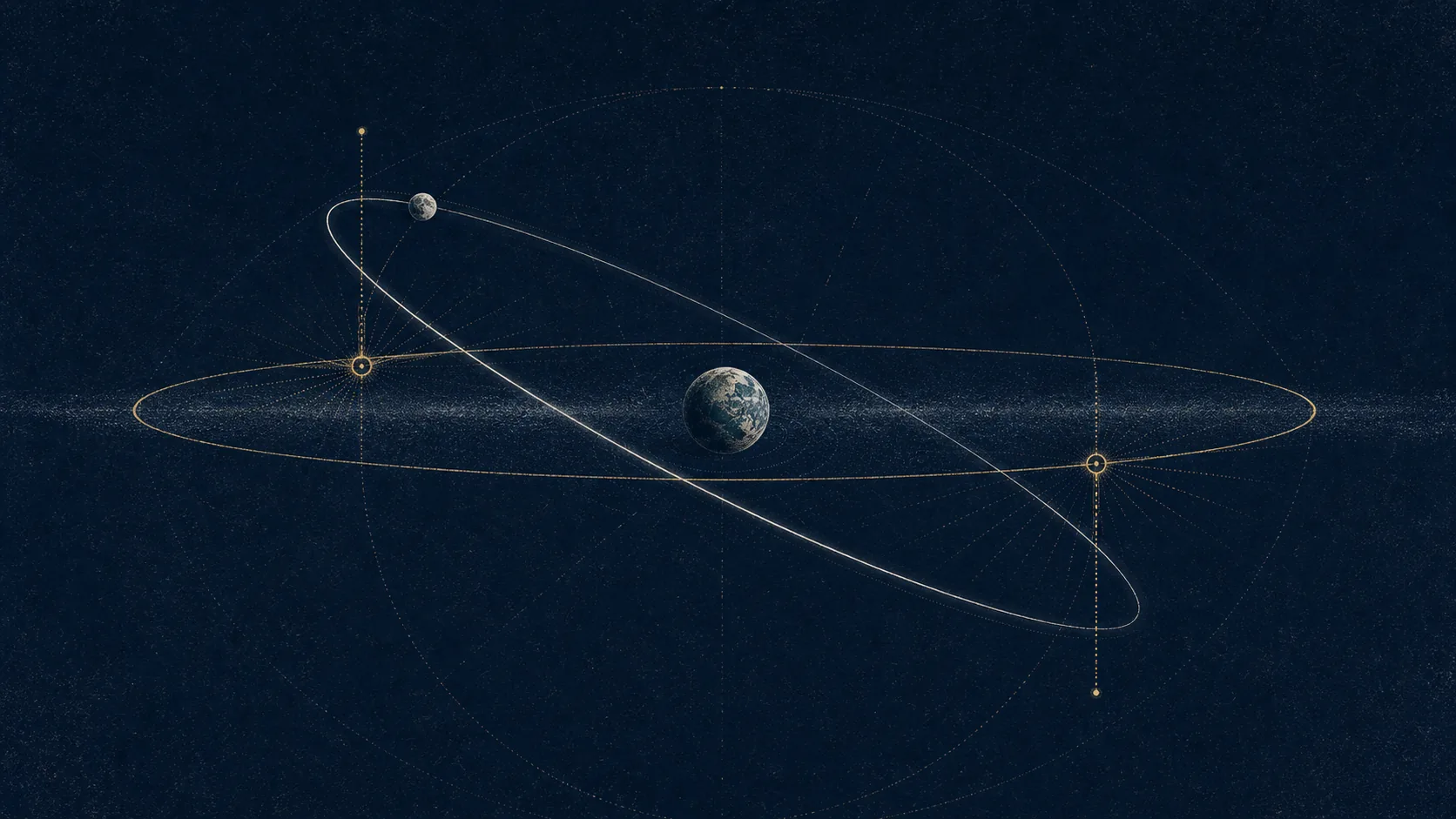
The North Node is not a planet, asteroid, or physical object. It is the ascending intersection of two paths: the Moon’s orbit around Earth and the ecliptic, the Sun’s apparent yearly path through the zodiac. The opposite intersection is the South Node. Because both points belong to the same geometry, they always sit exactly 180 degrees apart and must be read as one axis.
Astrologers use the North Node to describe qualities that may need conscious effort because they are not the first or easiest response. The South Node marks the other end of the pattern: familiar reactions, established abilities, and habits that may be useful until they become the default. This is an astrological reading method, not scientific evidence that a calculated point determines fate or personality.
- North Node symbol: ☊, also called the ascending lunar node.
- South Node symbol: ☋, always at the opposite sign, degree, and house axis.
- The nodal cycle lasts about 18.6 years, so the nodes remain in one sign for roughly a year and a half.
How to find your North Node
A North Node calculator uses your birth date to calculate the node’s zodiac longitude. The nodes move slowly, so the sign is usually stable across a single day. Exact time and place still matter when you want the natal house, an accurate degree, contacts to angles, and a reliable house ruler route. If the node is close to a house cusp, a small birth-time difference or a different house system can change the house shown.
A complete result should identify more than a sign. Look for the exact degree, natal house, opposite South Node, the ruler of the North Node sign, and tight aspects from natal planets. Regu uses the astronomical True Node and states that method in the result, so you can compare it responsibly with software that may use the Mean Node instead.
- Use the recorded local birth time whenever possible.
- Use the sign for style and the house for the part of life where the pattern becomes visible.
- Read the opposite South Node before interpreting either end in isolation.
The North–South Node axis
A common shorthand says to leave the South Node behind and become the North Node. It is memorable, but it makes for a poor chart reading. The South Node can show genuine competence and hard-won experience. Trouble begins only when that familiar response is used in every situation. The North Node introduces another option; it does not cancel the first one.
Take an Aries North Node with a Libra South Node. Cooperation and awareness of other people are already part of the picture. What needs attention is the moment when keeping the peace becomes a reason not to choose. Aries contributes initiative and a clearer sense of personal position. The useful reading lies in that adjustment, not in declaring one sign good and the other bad.
North Node meaning in all 12 signs
The sign describes the manner in which the less familiar side of the axis is approached. It is generational—everyone born during the same nodal period shares it—so sign alone is never the whole interpretation. The house, ruler, degree, and close aspects supply the personal detail.
- North Node in Aries / South Node in Libra: decisions cannot always wait for agreement. Aries calls for a personal position and the courage to act on it; the Libra skills of tact and proportion are still useful, provided they do not become chronic hesitation.
- North Node in Taurus / South Node in Scorpio: steadiness is the unfamiliar medicine. Building personal resources and tolerating an ordinary, peaceful pace can matter more than another crisis, even when the Scorpio end of the axis is exceptionally good at reading intensity.
- North Node in Gemini / South Node in Sagittarius: ask the next question before defending the final answer. Conversation, local detail, and evidence loosen the grip of a worldview that may be compelling but too certain of itself.
- North Node in Cancer / South Node in Capricorn: competence comes easily; admitting a private need may not. Cancer shifts attention toward emotional presence, care, and a home life that is not treated as an afterthought to achievement.
- North Node in Leo / South Node in Aquarius: step out from behind the group and put a name on what you make. The collective perspective remains valuable, but it should leave room for warmth, authorship, and a visible personal stake.
- North Node in Virgo / South Node in Pisces: sensitivity needs a workable form. Clear limits, useful routines, and attention to craft allow imagination to function without letting every demand or feeling blur into the next.
- North Node in Libra / South Node in Aries: other people are not simply obstacles or an audience. Negotiation, reciprocity, and shared decisions broaden the strong self-starting instinct already present at the Aries end.
- North Node in Scorpio / South Node in Taurus: security cannot depend on keeping every condition unchanged. Scorpio makes room for shared stakes, honest dependence, and the kind of change that intimacy inevitably brings.
- North Node in Sagittarius / South Node in Gemini: facts need a direction. The task is to form a considered point of view—through study, travel, teaching, or lived conviction—without losing Gemini’s willingness to revise it.
- North Node in Capricorn / South Node in Cancer: the emphasis falls on structure, accountability, and a public role that can withstand pressure. Private bonds remain the base, but they cannot be the only place where authority feels safe.
- North Node in Aquarius / South Node in Leo: personal talent finds a wider use through friendship, community, and systems. Recognition is not forbidden; it simply stops being the sole measure of whether the contribution matters.
- North Node in Pisces / South Node in Virgo: not everything can be improved by tighter control. Pisces opens a place for trust, imagination, and uncertainty, while Virgo’s discernment keeps receptivity from becoming confusion.
North Node meaning in all 12 houses
The house places the axis in a specific part of life. It depends on birth time and location, unlike the slowly moving sign. Read both houses, then add the node’s sign and its ruler. If the degree falls near a cusp, check the recorded time and compare house systems before drawing a firm conclusion.
- North Node in the 1st house / South Node in the 7th: begin from your own position. Partnership experience is an asset, but identity weakens when every choice is first measured against someone else’s response.
- North Node in the 2nd house / South Node in the 8th: personal income, values, and self-trust need a firmer base. Shared resources and emotional entanglements cannot carry the entire burden of security.
- North Node in the 3rd house / South Node in the 9th: the immediate world deserves attention—siblings, neighbors, conversation, writing, and the facts in front of you. Grand theories work better when they remain answerable to daily evidence.
- North Node in the 4th house / South Node in the 10th: public competence may already be well rehearsed. The unfinished work is often private: home, family history, emotional roots, and a place to stand when no audience is present.
- North Node in the 5th house / South Node in the 11th: make something that bears your signature. Romance, play, pleasure, and creative risk draw the person out of the safety of group identity.
- North Node in the 6th house / South Node in the 12th: give the day a shape. A repeatable routine, a practical skill, or a clear responsibility can prevent retreat and sacrifice from becoming shapeless habits.
- North Node in the 7th house / South Node in the 1st: partnership becomes a place of learning rather than a limit on independence. The point is to encounter another person’s reality without giving up the initiative already available in the 1st house.
- North Node in the 8th house / South Node in the 2nd: deeper bonds require more than self-sufficiency. Questions of trust, shared money, loss, and mutual responsibility ask for participation rather than control from a safe distance.
- North Node in the 9th house / South Node in the 3rd: scattered information needs a larger frame. Study, teaching, travel, ethics, or belief can provide it, as long as curiosity is not sacrificed for certainty.
- North Node in the 10th house / South Node in the 4th: visibility and vocational definition cannot be postponed indefinitely. A strong private base should support public responsibility, not provide a permanent place to hide from it.
- North Node in the 11th house / South Node in the 5th: creativity enters a social field. Friendship, networks, and shared aims reveal what a personal talent can do when it is not required to keep its maker at center stage.
- North Node in the 12th house / South Node in the 6th: productivity is not the only useful measure of a day. Solitude, rest, endings, and inner life need space, while 6th-house skills help keep that space from turning into avoidance.
Aspects and the ruler make the North Node more personal
Because many people share the same North Node sign, the most individual information often comes from the house, its ruler, and close natal aspects. A planet conjunct the node participates directly in the nodal story. Squares can describe recurring pressure around the axis; trines and sextiles can show functions that support it more naturally. Keep the orb tight and do not treat every wide contact as equally important.
Then follow the traditional ruler of the North Node sign. For Libra, inspect Venus by sign, house, and aspect. For Aquarius, start with Saturn; for Pisces, start with Jupiter. The ruler connects the node to the rest of the chart and keeps the interpretation from collapsing into a slogan.
- Start with conjunctions and close major aspects.
- Read an opposition as a conjunction to the South Node as well as an opposition to the North Node.
- Check whether the node ruler is angular, retrograde, dignified, or tightly connected to the Sun, Moon, or chart ruler.
True Node vs Mean Node
The Mean Node is a smoothed mathematical average that moves backward through the zodiac at a steady rate. The True Node follows the Moon’s actual nodal oscillation more closely, so it can move slightly forward for short periods. Both methods describe the same lunar-node geometry, but their exact degrees can differ and, near a sign or house boundary, they can produce different labels.
There is no need to hide the choice. Use a calculator that states its method, compare both positions if your node sits close to a boundary, and stay consistent when tracking returns or transits. Regu uses the True Node. The South Node is then placed exactly opposite the calculated North Node.
- Mean Node: averaged and continuously retrograde.
- True Node: oscillating and capable of brief direct motion.
- A method difference matters most near sign, house, or aspect-orb boundaries.
How to read the result without losing the thread
Start with the axis rather than a one-line statement about destiny. Write down both signs and both houses. What comes easily at the South Node end? When is that response useful, and when does it narrow the options? Only then add the North Node, its ruler, and the closest major aspects.
Consider a North Node in the 10th house opposite a 4th-house South Node. It does not guarantee status or success. A more defensible reading is that public responsibility and vocational definition require attention, while privacy or family familiarity is easier to fall back on. The chart has identified a tension; what a person does with it remains an open question.
- 1. North Node sign and opposite South Node sign.
- 2. North Node house and opposite South Node house.
- 3. Traditional ruler of the North Node sign.
- 4. Tight conjunctions and major aspects.
- 5. Repeating themes elsewhere in the birth chart.
Find your True North Node sign, house, ruler, and closest aspects.
Calculate the exact nodal axis first, then use the guide to read its sign, house, South Node counterweight, and natal contacts in context.
Frequently asked questions
What is my North Node?
Your North Node is the ascending lunar node calculated for your birth moment. A calculator can show its sign, exact degree, natal house, opposite South Node, ruler, and closest aspects.
Is the North Node the same as the True Node?
The True Node is one calculation model for the North Node. Some charts use the smoothed Mean Node instead. They describe the same nodal axis but can differ slightly by degree.
Do I need my birth time to find my North Node?
The sign can usually be found from the birth date because the nodes move slowly. Exact time and place are still needed for a reliable house, angle contacts, and precise birth-chart context.
Is the North Node a planet?
No. It is the point where the Moon’s orbit crosses the ecliptic northward. The South Node is the opposite crossing point.
How long does the North Node stay in one sign?
Roughly a year and a half. The full nodal cycle takes about 18.6 years, although the exact entry and exit dates depend on whether True or Mean Node is used.
Which matters more: North Node sign or house?
They answer different questions. The sign describes the developmental style; the house shows the life area where it becomes concrete. The ruler and close aspects provide further context.
Should I leave my South Node behind?
No. The South Node can describe familiar skills and responses. The aim is to keep those resources available without letting them replace every less familiar North Node practice.
Why do two North Node calculators disagree?
They may use True Node versus Mean Node, different house systems, different time-zone data, or different birth details. Compare the stated method, exact degree, and input data before interpreting the difference.
Sources and methodology
The lunar nodes are calculated points rather than physical bodies. Regu reports the selected true-node or mean-node method and keeps that setting consistent through a reading. Sign interpretation can usually be made from the date; houses and angle contacts require reliable time and place. Interpretive meanings are an astrological framework, not scientific evidence of fate, personality, or past lives. Source checked August 1, 2026.
- Swiss Ephemeris documentation: lunar nodesAstrodienst