
August 28, 2026 Lunar Eclipse in Pisces: Exact Time, Visibility, and Your Chart
A deep partial lunar eclipse arrives at 4°54′ Pisces. Here is what can be observed, where it is visible, and a careful way to place it in a birth chart.
In this article
In short
- One eclipse, two useful clocks: the shadow reaches its maximum just before the exact Full Moon
- Partial phase: approximately 02:34–05:52 UTC on August 28.
- First: note the Pisces–Virgo house axis, only if the birth time is reliable.
The short version, with the clocks kept separate
The partial lunar eclipse happens on August 27–28 in the Americas and during the early hours of August 28 across Europe and Africa. Its visible partial phase runs from about 02:34 to 05:52 UTC, with maximum eclipse near 04:13 UTC. The U.S. Naval Observatory places the exact Full Moon at 04:18 UTC. Those two times do not conflict: one measures the geometry of Earth’s shadow across the lunar disk, while the other marks the Sun–Moon opposition.
In a tropical, geocentric zodiac calculation, the Moon reaches 4°54′ Pisces at that opposition, opposite the Sun at 4°54′ Virgo. The degree is useful for a personal chart comparison. It does not change who can see the eclipse, and it should not be presented as an astronomical constellation coordinate. Astronomy and astrological interpretation are doing different jobs here.
- Partial phase: approximately 02:34–05:52 UTC on August 28.
- Maximum eclipse: approximately 04:13 UTC; exact Full Moon: 04:18 UTC.
- Astrological position: 4°54′ Pisces, opposite 4°54′ Virgo.
- NASA umbral magnitude: 0.930, describing the fraction of the Moon’s diameter immersed in Earth’s umbra at maximum.
What the sky will actually show
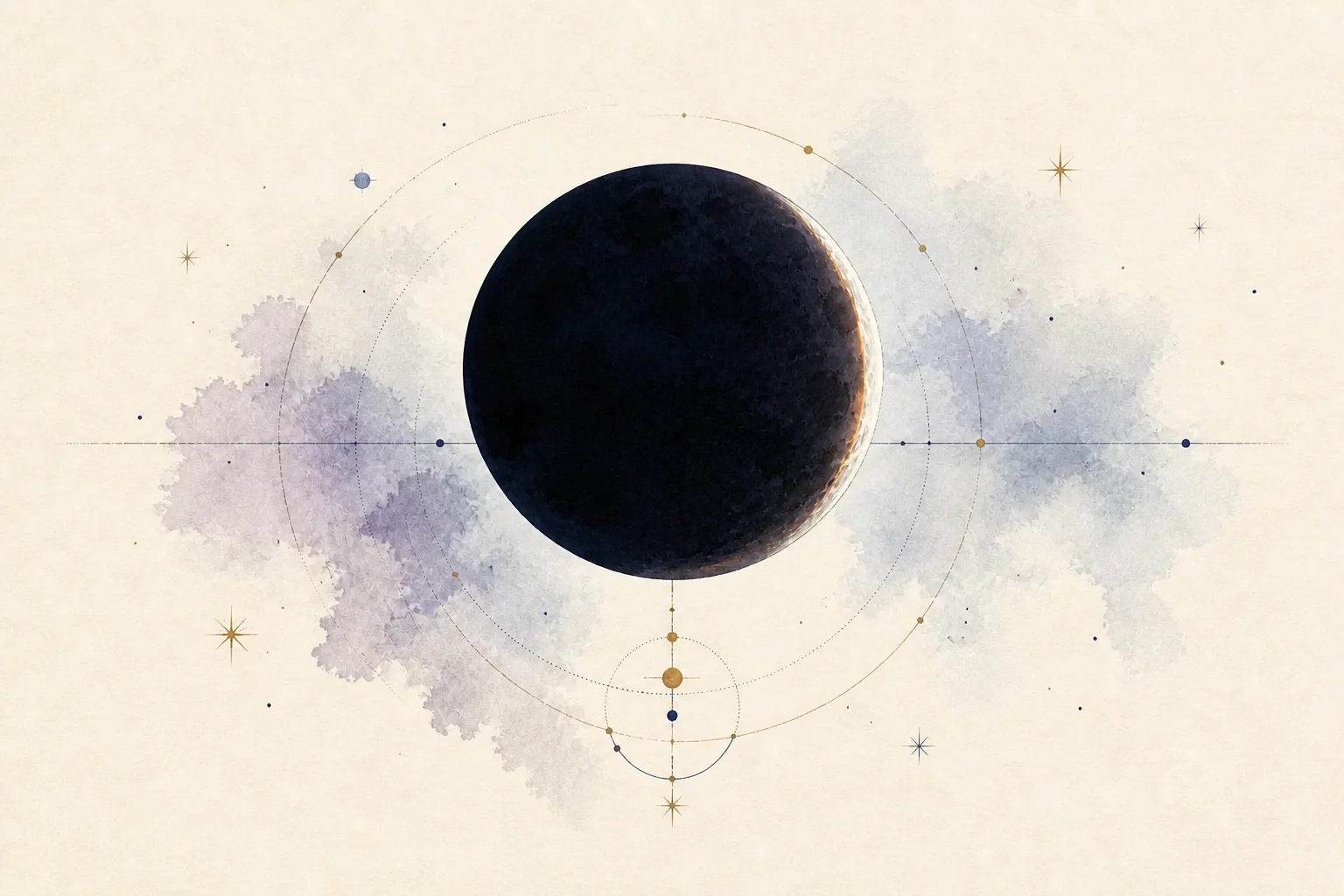
This is a deep partial eclipse rather than a total one. Earth’s dark umbral shadow will cover most of the Moon, but a bright edge remains outside it. The partial phase lasts a little over three hours. No eclipse glasses are needed: unlike a solar eclipse, every stage of a lunar eclipse is safe to view with the unaided eye, binoculars, or a telescope.
NASA lists the eastern Pacific, the Americas, Europe, and Africa as the broad visibility region. That line needs one qualification. A region can appear on the map while a particular city sees only part of the event because the Moon rises late or sets early. Much of North and South America gets the most comfortable view. Western Europe sees the Moon low in the west toward dawn; farther east, it sets earlier in the sequence. A clear western horizon matters as much as the country name.
Local time changes the experience, not the eclipse
For New York, maximum falls just after midnight, near 12:13 a.m. EDT on August 28. Los Angeles sees it around 9:13 p.m. PDT on August 27. Madrid and Rome reach maximum near 6:13 a.m. local summer time, with the Moon already low. These conversions are useful for planning, but they are not a promise of visibility: buildings, haze, local moonset, and the horizon can shorten the view.
If you are outside these examples, convert 04:13 UTC to your location and then check whether the Moon is above the horizon. Do not assume the maximum is the only worthwhile moment. When moonset comes first, the beginning of the partial phase may be the part you can actually observe.
Begin the chart reading with one coordinate: 4°54′ Pisces
Open a birth chart and find the house containing 4°54′ Pisces. Then look directly opposite, at 4°54′ Virgo. That house axis gives the eclipse a setting. If Pisces falls in the fourth house and Virgo in the tenth, for example, the useful subject is the negotiation between private foundations and public responsibility. It is not evidence that a family or career event must occur.
A reliable birth time matters for houses. If the time is unknown or approximate, skip house claims and compare the degree only with natal planets. This is a better limitation than assigning a confident house from a noon chart. The Moon’s natal sign is still available without a precise birth time in many cases, but the Ascendant and house cusps are not.
- First: note the Pisces–Virgo house axis, only if the birth time is reliable.
- Second: check natal planets or angles near 4°54′ of Pisces, Virgo, Gemini, or Sagittarius.
- Third: give the smallest orb the most attention; a contact within 1° is more specific than one almost 3° away.
- Last: connect the symbolism to an existing situation rather than inventing an event to match the chart.
A worked comparison shows why Sun-sign forecasts flatten the story
Consider two people who both have a Pisces Sun. In the first chart, 4°54′ Pisces sits in the tenth house and falls within half a degree of natal Saturn. A reasonable reading would examine a visible responsibility, a professional boundary, or the cost of holding a role together. The Saturn contact makes this more specific than the person’s Sun sign alone.
In the second chart, the eclipse degree falls in the third house and makes no close major aspect. Here it may be more useful as a prompt around information, a conversation, or a daily route that has become hard to manage. The volume is lower because there is no tight natal contact. Calling both people ‘the signs most affected’ would erase the part of the chart that actually distinguishes them.
The same restraint applies when nothing close appears. An eclipse can be visually memorable and culturally interesting without becoming a major personal turning point. A chart reading should be allowed to return a quiet result.
What the Pisces–Virgo axis can help you notice
Astrologically, Pisces and Virgo organize two different ways of meeting disorder. Virgo separates, names, edits, and improves what can be handled. Pisces notices what exceeds the system: fatigue, grief, imagination, empathy, ambiguity, and the need to let a process breathe. Neither side is the cure for the other. The axis becomes useful when one mode has been asked to do every job.
A concrete question is better than a prediction. Where have you kept refining a routine that is no longer solving the original problem? Where has openness become avoidance because no boundary was ever named? The house axis tells you where to look; a close natal aspect suggests which inner function is already involved. The eclipse itself does not choose an outcome.
Make one note before the eclipse and read it again afterward
Before August 28, write down one situation on the Pisces–Virgo house axis that is already active. Record what you know, what you are assuming, and what would count as a meaningful change. Return to the note a week later and again near the next New Moon. This creates a small record instead of relying on hindsight, which is very good at turning ordinary events into a perfect astrological story.
- Name the situation in one sentence, without eclipse language.
- Separate observable facts from interpretations.
- Choose one modest action you control, such as asking a question or changing a routine.
- When you review the note, keep coincidences interesting without treating them as proof.
See how this pattern shows up in your actual birth chart.
Open your chart and look at your planets, houses, angles, and aspects in one place instead of reading the pattern in the abstract.
Frequently asked questions
What time is the August 28, 2026 lunar eclipse?
The visible partial phase runs approximately from 02:34 to 05:52 UTC, with maximum near 04:13 UTC. The exact Full Moon occurs a few minutes later, at 04:18 UTC. Convert the UTC times and check local moonrise or moonset for your city.
Where is the August 2026 lunar eclipse visible?
NASA lists the eastern Pacific, the Americas, Europe, and Africa. The Americas receive the most complete nighttime view; parts of Europe and Africa see it toward dawn, sometimes only before the Moon sets.
What degree is the lunar eclipse in astrology?
At the exact Full Moon, the tropical geocentric position is about 4°54′ Pisces, opposite the Sun at 4°54′ Virgo. Different software may differ by a few arcminutes depending on the time and ephemeris used.
Which zodiac signs are most affected by the Pisces eclipse?
A Sun-sign list is too broad. Check for natal planets or angles close to 4°54′ Pisces, Virgo, Gemini, or Sagittarius, then consider the house axis if the birth time is reliable. A tight contact is more relevant than sharing one of those signs somewhere in the chart.
Sources and methodology
Event type, visibility, umbral magnitude, and duration were checked against NASA GSFC eclipse data. The Full Moon time was checked against the U.S. Naval Observatory. The 4°54′ Pisces position was calculated for 2026-08-28 04:18 UTC with Astronomy Engine 2.1.19 using tropical geocentric longitudes. Rounded civil times can vary by about a minute across ephemerides; the astrological reading is an optional interpretive layer, not a scientific forecast. Sources and calculations were reviewed on August 13, 2026.
- Lunar Eclipses: 2021–2030NASA Goddard Space Flight Center
- Eclipses and the MoonNASA Science
- Moon phases for 2026U.S. Naval Observatory
- Astronomy EngineCosineKitty