South Node Conjunct Venus: Familiarity, Ease, And Repeated Patterns
How to examine familiar attraction while keeping memory, repetition, and present-day compatibility separate.
Practical guides for the questions that bring you to a calculator—what a placement means, what a timing technique shows, and how to read a relationship pattern clearly.
All guides
60 guides found

How to examine familiar attraction while keeping memory, repetition, and present-day compatibility separate.

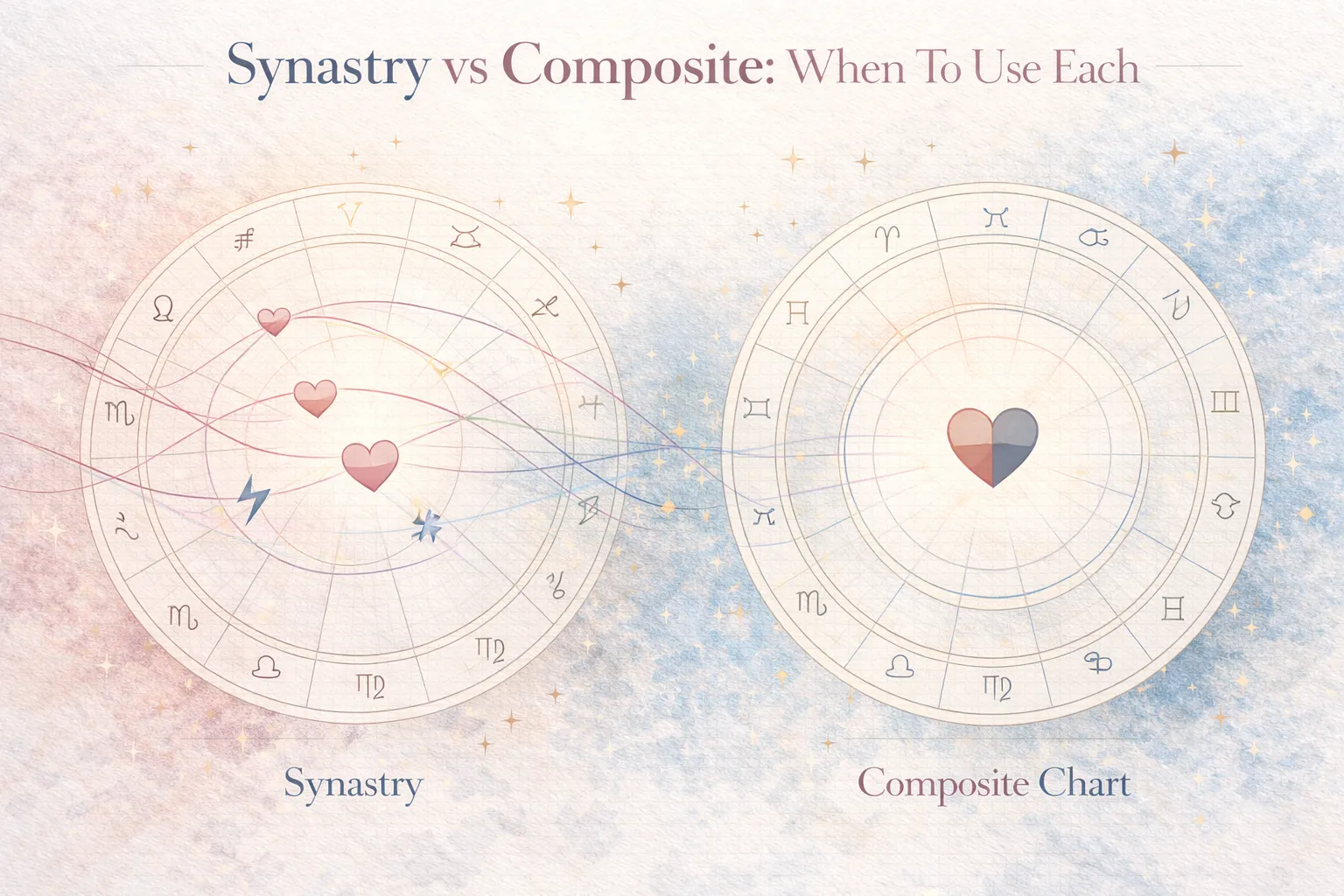
A practical comparison of synastry and composite charts so you know what each tool calculates, which questions each one answers, and the cleanest order for reading them together.

A birth-time-sensitive guide to Moon–Vertex contacts, emotional immediacy, and the limits of a single synastry point.

How a Sun–Vertex contact can make one person conspicuous while exact birth data and the wider chart keep the reading in proportion.

A grounded reading of Venus–Vertex attraction that accounts for exact birth times, setting, reciprocity, and the rest of the chart.

A reflective method for reading the Moon, fourth house, Venus, and Saturn without treating a chart as a mental-health assessment.

Use the Moon's sign, house, and aspects to reflect on emotional pace and everyday recovery without turning astrology into diagnosis.

A careful way to explore repeated effort through Saturn, Mars, house rulers, and real behavior without assigning a hidden wound.

How Moon, fourth-house, Venus, node, and angle contacts can frame early familiarity without treating it as earned trust.

A reading order for the Ascendant, chart ruler, luminaries, houses, and repeated patterns—without trying to decode everything at once.

Understand houses as life areas, then use cusp signs, rulers, planets, and timing to build a specific chart reading.

A method for comparing one date with a birth chart while separating personal contacts from background sky.